Fuel Planning for a Long Weekend: How to Never Get Stranded on the Water
That quiet, creeping anxiety is something almost every boater has felt at some point. Running out of fuel on the water is not just embarrassing. It's genuinely dangerous. You lose steerage, you lose the ability to respond to changing weather, and you becom

Dwayne Rodrigues
Boat Owner & Enthusiast
Quick Takeaways: Running out of fuel is the single most common cause of boater distress calls in Canada. The Rule of Thirds is your most important fuel planning tool: use one-third of your tank to get to your destination, one-third to return, and keep one-third in reserve for emergencies. Before you leave the dock, calculate your boat's real-world fuel consumption, identify fuel stops along your route, and follow Transport Canada's mandatory fuelling safety procedures to the letter. Key rules: never fill past 90% capacity, always ground the nozzle against the filler pipe, and run your blower for a minimum of four minutes before starting an inboard engine.
The Quiet Panic of a Dropping Fuel Gauge
Picture this. It's a long weekend in July, and you're somewhere out on Lake Erie, halfway between Port Dover and the Long Point sandbar. The sun is blazing, the water is a deep, gorgeous blue, and the whole weekend is ahead of you. Then you glance down at the fuel gauge. It's lower than you expected. A lot lower. The kind of lower that makes your stomach drop a little.
That quiet, creeping anxiety is something almost every boater has felt at some point. Running out of fuel on the water is not just embarrassing. It's genuinely dangerous. You lose steerage, you lose the ability to respond to changing weather, and you become a hazard to other vessels. According to BOATsmart! Canada, running out of fuel is the number one cause of boater distress on the water. And here's the thing: it is almost entirely preventable.
This guide is about making sure that never happens to you. Whether you're heading out for a two-day trip to the Pottahawk sandbar, a long weekend cruise along the north shore, or a multi-day trip through the Trent-Severn, the principles are the same. Good fuel planning is not complicated, but it does require discipline and a bit of math. Let's walk through it.
The Rule of Thirds: The Foundation of Fuel Planning
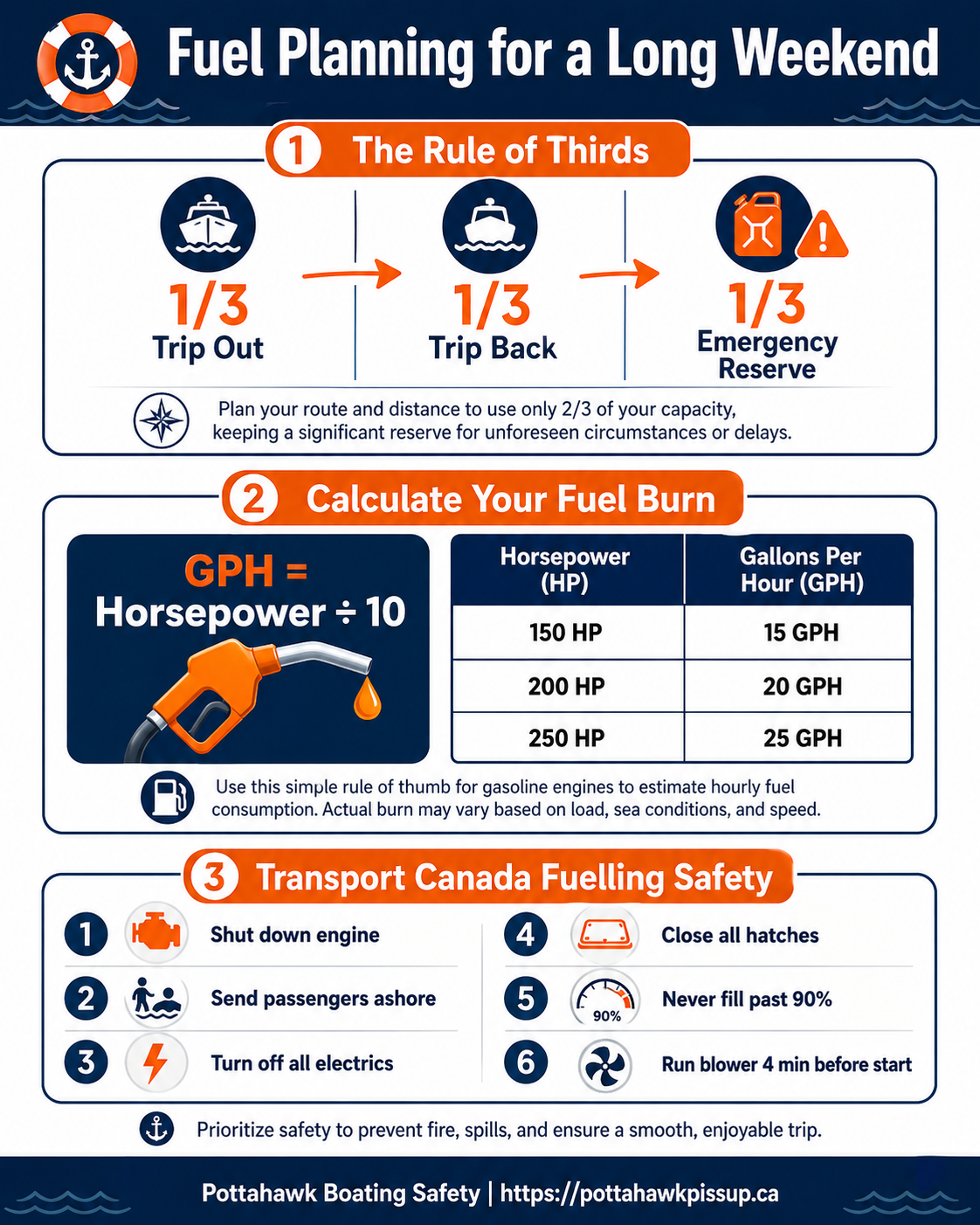
If you learn nothing else from this article, learn the Rule of Thirds. It is the single most important concept in recreational boat fuel management, and it is endorsed by Transport Canada, BOATsmart! Canada, and every serious boating safety organization in the country.
The rule is simple. Before you leave the dock, you should have enough fuel to cover three equal legs of your journey:
One-third for the trip out. This is the fuel you'll use getting from your home port to your destination. If you're heading to Long Point Bay, this covers the outbound leg.
One-third for the trip back. This is your return fuel. Same distance, same conditions (roughly), same consumption.
One-third in reserve. This is the part most boaters underestimate. That final third is not for casual use. It is your emergency buffer. It covers unexpected detours when weather forces you to take a longer route home. It covers the hour you spend idling in a crowded anchorage waiting for a spot. It covers helping another boater who has run into trouble. It covers the mechanical issue that forces you to run at a much slower speed than planned. It is the difference between a bad day and a genuinely dangerous situation.
The practical implication of the Rule of Thirds is that you should never leave the dock with less than a full tank if you're heading out for a full day or a long weekend. If your tank is only three-quarters full, your effective range is reduced significantly. Top up before you leave, every single time.
Calculating Your Boat's Real-World Fuel Consumption
To use the Rule of Thirds effectively, you need to know how much fuel your boat actually burns. This is a number you should know as well as you know your boat's registration number. It changes based on several factors, but you need a reliable baseline.
The Horsepower Formula
The most widely used rule of thumb for gasoline engines is that they consume approximately one gallon per hour for every 10 horsepower at wide-open throttle. A 150-horsepower outboard, for example, will burn roughly 15 gallons per hour at full throttle. A 250-horsepower engine will burn around 25 gallons per hour. This is a rough estimate, and it varies by engine design, hull type, and conditions, but it gives you a starting point.
The formula is: GPH (gallons per hour) = Total Horsepower ÷ 10
For diesel engines, the formula is different. Diesel engines are significantly more fuel-efficient than gasoline engines. A rough estimate for diesel is 0.06 gallons per hour per horsepower. A 200-horsepower diesel engine will burn approximately 12 gallons per hour at full throttle.
The Real-World Test
The horsepower formula is a starting point, not a final answer. The most accurate way to know your boat's fuel consumption is to measure it directly. Here's how to do it:
Fill your tank to the brim at the fuel dock. Note the exact reading on your fuel gauge and the time. Then go for a run at your typical cruising speed for a set period, say one hour. Return to the fuel dock and fill the tank back to the same level. The number of litres or gallons you added is your actual consumption rate at that speed. Do this a few times under different conditions and you'll have a reliable average to work with.
It's worth noting that most modern boats with digital displays can show you real-time fuel consumption. If your boat has this feature, use it. It takes the guesswork out of the equation entirely.
What Changes Your Fuel Burn
Your consumption rate is not fixed. Several factors will push it up or down on any given day.
Speed is the biggest variable. Running at two-thirds throttle instead of wide-open throttle can reduce fuel consumption by 30 to 50 percent, depending on the hull design. Most recreational boats have a "sweet spot" where they're planing efficiently without burning excessive fuel. For many boats, this is somewhere between 3,000 and 4,000 RPM. Learn your boat's sweet spot and use it.
Weight matters more than most people realize. Every extra person, cooler, bag, and piece of gear on board adds to the load your engine has to push through the water. A fully loaded boat for a long weekend trip can burn noticeably more fuel than the same boat with just the captain on board.
Wind and waves are the wild cards. Running into a headwind or against a chop requires significantly more power than running in calm conditions. If you're planning a long weekend trip and the forecast calls for strong southwest winds, factor in higher fuel consumption on the return leg if you're heading back into the wind.
Hull condition plays a role too. A clean, smooth hull slips through the water with minimal resistance. A hull covered in algae, barnacles, or other marine growth creates drag that forces the engine to work harder. If you're doing a lot of boating, keep your hull clean.
Fuelling Safety: Transport Canada's Non-Negotiable Rules
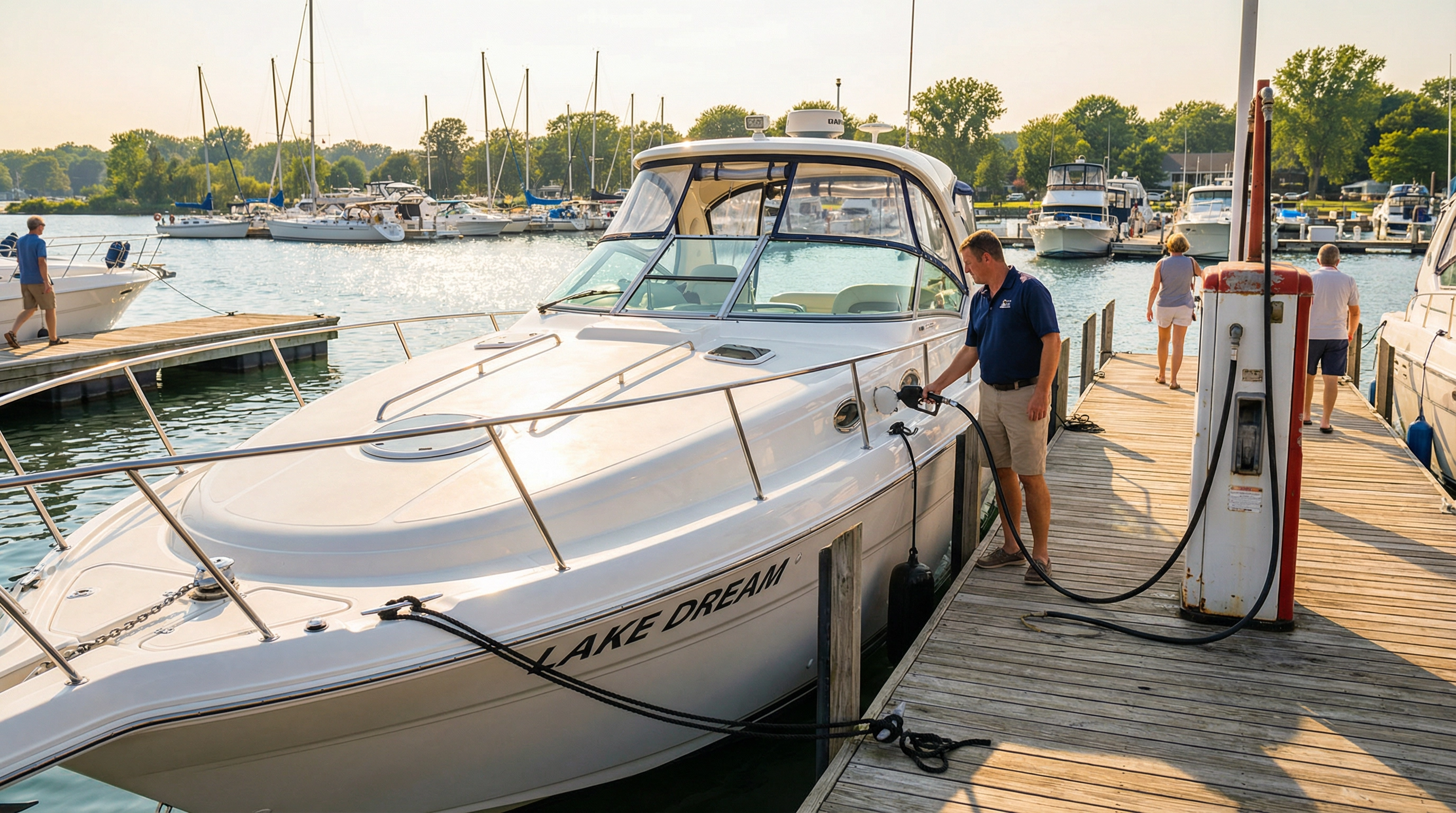
Fuelling a boat is not like filling up your car. Gasoline vapours are heavier than air. They sink to the lowest point of your boat, which is the bilge, and they can accumulate there in concentrations that are explosive. A single spark from an electrical switch, a radio, or even static electricity can ignite those fumes. Boat fires and explosions at fuel docks do happen, and they are catastrophic. Following the correct fuelling procedure is not optional. It is a legal requirement under the Canada Shipping Act and a matter of basic safety.
Here is the complete Transport Canada fuelling procedure, in order:
Before you touch the nozzle: Moor the boat securely to the dock. Shut down all engines. Extinguish all open flames, including cigarettes, cigars, and any galley stoves or barbecues. Send all passengers ashore. Turn off all electrical equipment, including radios, battery masters, and navigation lights. Close all doors, windows, hatches, and ports to prevent fumes from entering the cabin.
During fuelling: If you're filling portable tanks, remove them from the boat and fill them on the dock. This way, any spill lands on the dock rather than in the boat. For fixed tanks, keep the fuel nozzle in firm contact with the filler pipe at all times. This grounds the nozzle and prevents static sparks. Do not fill the tank past 90 percent capacity. Fuel expands as it warms up, and overfilling can cause fuel to overflow through the vent into the water, creating both a fire hazard and an environmental violation. Clean up any spills immediately with absorbent materials and dispose of them in approved containers.
After fuelling: Open all hatches, doors, and ports to ventilate the boat. Wait several minutes, then use your nose. If you smell any gasoline, do not start the engine. Increase ventilation and wait longer. If you have an inboard engine, run the engine compartment blower for a minimum of four minutes before attempting to start the engine. This is not a suggestion. It is a requirement. Only when you are certain there are no fumes should you allow passengers back on board and start the engine.
Planning Your Fuel Stops for a Long Weekend
A long weekend trip requires more planning than a day trip. You need to think about where you can refuel along your route, what the hours are at those marinas, and what happens if your primary fuel stop is closed or out of service.
Start by mapping your route and identifying every marina with a fuel dock within a reasonable distance. Our guide to the best marinas near Pottahawk is a good starting point for trips in the Long Point Bay area. Note the hours of operation for each fuel dock, because many smaller marinas close early on long weekends when staff are stretched thin. Call ahead if you're planning to arrive late in the day.
Always have a backup fuel stop identified. If your primary stop is closed, out of fuel, or has a long lineup, you need to know where the next option is. Running to your primary stop on the assumption it will be open, only to find it closed, can put you in a very difficult position if you're already running low.
Consider carrying a Transport Canada-approved portable fuel tank as a backup. Even a small five or ten-gallon portable tank can give you the range to reach the next fuel dock in an emergency. Make sure it's properly secured and stored in a ventilated area, away from any ignition sources.
The Long Weekend Mindset: Discipline Over Optimism
The most common mistake boaters make with fuel is optimism. They look at the gauge, think "that's probably enough," and head out anyway. They underestimate how much extra running they'll do at the destination. They don't account for the headwind on the way back. They forget that the boat is loaded heavier than usual. And then they end up on the radio, calling for a tow.
Good fuel planning is about discipline. It's about doing the math before you leave the dock, not guessing. It's about topping up even when you think you have enough. It's about respecting the Rule of Thirds as a hard limit, not a suggestion. As we discuss in our post on anchor failure scenarios and prevention, the best safety measures are the ones you put in place before you need them.
The pre-departure checklist is your best friend here. Our pre-trip inspection checklist walks through everything you should verify before leaving the dock, and fuel is at the top of that list. Check the level, calculate your range, confirm your fuel stops, and only then cast off the lines.
A long weekend on Lake Erie is one of the great pleasures of the Ontario boating season. The water, the sunsets, the camaraderie at the anchorage, all of it is worth the effort of getting there safely. Fuel planning is not the glamorous part of boating. But it is the part that ensures you get to enjoy all the glamorous parts, every single time.
Sources & Further Reading
Transport Canada: Safe Boating Guide
BOATsmart! Canada: Fuelling: The Rule Of Thirds
Drive a Boat Canada: What is Important to Remember When Fueling a Boat?
Boating Magazine: Calculating Boat Fuel Consumption
Alberni Power Marine: A Comprehensive Guide to Boat Fuel Consumption
Tags
Share
Read Next
 Resources
Boat Insurance in Ontario: What It Covers, What It Costs, and What Most Boaters Get Wrong
Let me ask you a question. If you back your boat into a slip at Port Dover and accidentally crunch the fiberglass on the cruiser next to you, who pays for it? What if a sudden summer squall rips through the anchorage at Pottahawk and your anchor drags,

Dwayne Rodrigues
Boat Owner & Enthusiast
 Resources
How to Summerize Your Boat: The Complete Spring Checklist for Canadians
There is a specific feeling that hits every Canadian boater around late April or early May. The ice has finally melted off Lake Erie, the sun is starting to feel genuinely warm, and you catch yourself staring at the boat trailer in the driveway. You know
Dwayne Rodrigues
Boat Owner & Enthusiast
 Resources
Transport Canada Boating Rules: The Complete Guide
Navigating the waters of Canada offers some of the most spectacular recreational boating in the world, from the vast expanses of the Great Lakes to the intricate networks of coastal inlets. However, this privilege comes with a profound responsibility.
Dwayne Rodrigues
Boat Owner & Enthusiast