How to Read Nautical Charts for Beginners
If you are new to boating on Lake Erie, looking at a nautical chart for the first time can feel like trying to read a foreign language. There are numbers scattered everywhere, strange symbols, and intersecting lines that do not seem to make much sense.

Dwayne Rodrigues
Boat Owner & Enthusiast
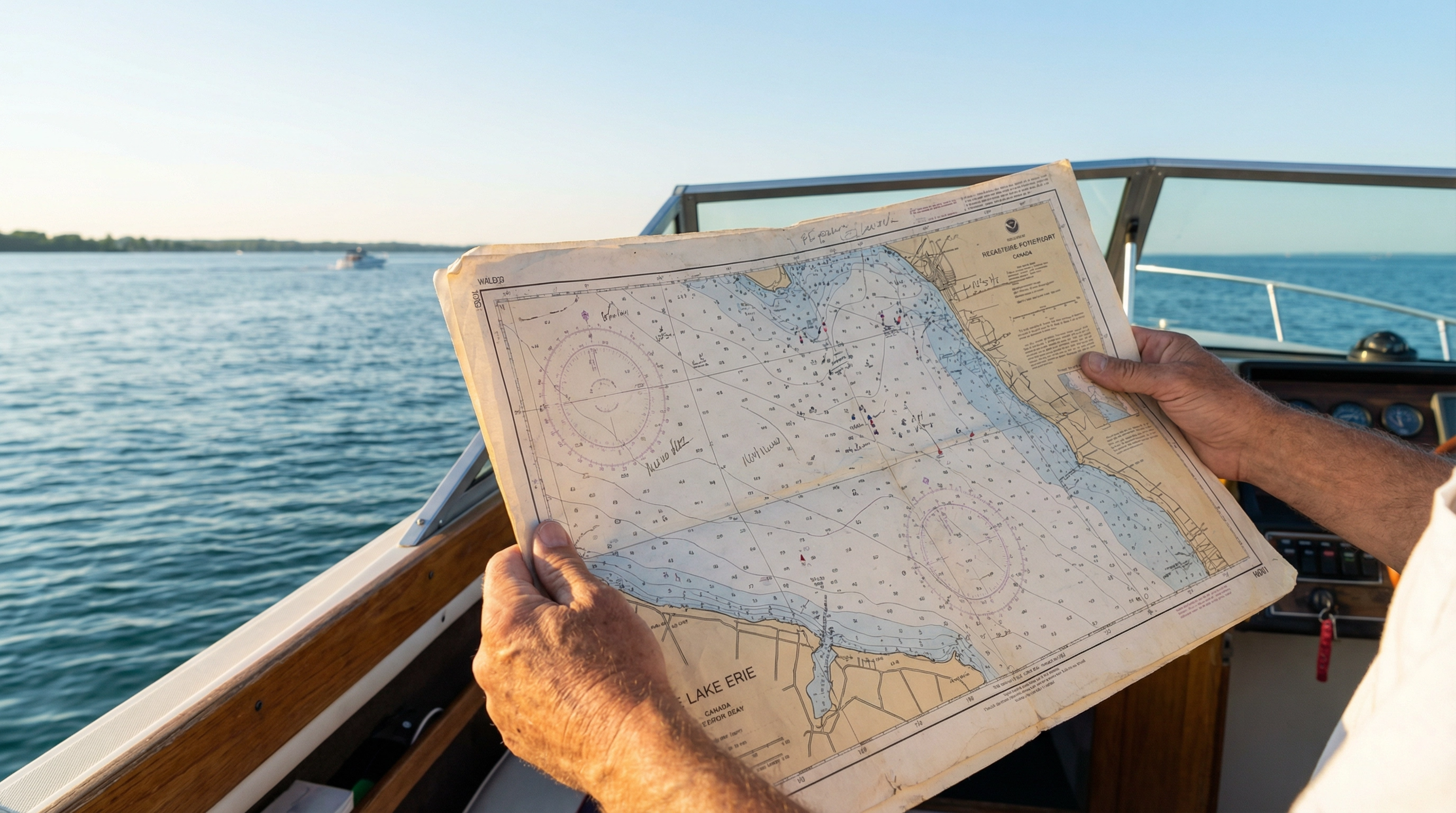
Quick Takeaways
Canadian charts use the IALA Region B system, meaning "red right returning" (keep red buoys on your right when heading upstream).
Depths on Canadian charts are measured from Chart Datum, which is the lowest normal tide or water level, ensuring you always have at least the charted depth.
White or light blue areas indicate deep, safe water, while dark blue areas warn of shallow water and potential grounding hazards.
The title block is your starting point, providing crucial information like the chart's scale, depth units (metres vs. feet), and the specific datum used.
Always carry paper charts as a backup to digital chartplotters, as electronics can fail when you need them most.
If you are new to boating on Lake Erie, looking at a nautical chart for the first time can feel like trying to read a foreign language. There are numbers scattered everywhere, strange symbols, and intersecting lines that do not seem to make much sense. You know what? That is completely normal. Every experienced captain started exactly where you are right now.
The truth is, learning how to read nautical charts is one of the most important skills you can develop as a boater. It is the difference between confidently navigating a new channel and nervously hoping you do not hit a submerged rock. While modern GPS and digital chartplotters are incredible tools, they are only as good as the person interpreting the data on the screen. Plus, electronics can fail. Knowing how to read a traditional paper chart gives you a level of self-reliance that every boater needs.
Let me explain the basics of nautical charts, focusing specifically on what you need to know for Canadian waters and Lake Erie. We will break down the colours, the symbols, the depth soundings, and the buoy systems so you can start planning your trips with confidence.
Start with the Title Block
Before you even look at the water on the chart, you need to read the title block. This is essentially the legend and instruction manual for the specific chart you are holding. According to the Canadian Hydrographic Service, the title block contains critical information that dictates how you interpret everything else on the page.
Here is what you need to look for:
Scale: This tells you the ratio of the chart distance to the actual distance on the earth. A large-scale chart (like 1:20,000) shows a small area in great detail, perfect for navigating harbours or tricky channels like the entrance to Long Point Bay. A small-scale chart (like 1:500,000) covers a massive area but lacks the fine detail needed for close-quarters navigation.
Depth Units: This is arguably the most important piece of information. Does the chart measure depth in metres, feet, or fathoms? Assuming a chart is in feet when it is actually in metres could lead to a disastrous grounding. Most modern Canadian charts are transitioning to metres, but always verify.
Chart Datum: This is the reference plane for all the depth soundings on the chart. In Canada, chart datum is typically the lowest normal water level. This means the water is almost always deeper than what the chart says, giving you a built-in safety margin.
Decoding the Colours
Nautical charts use a standardized colour scheme to give you a quick visual understanding of the water's depth and safety. It is a simple system, but it is your first line of defence against running aground.
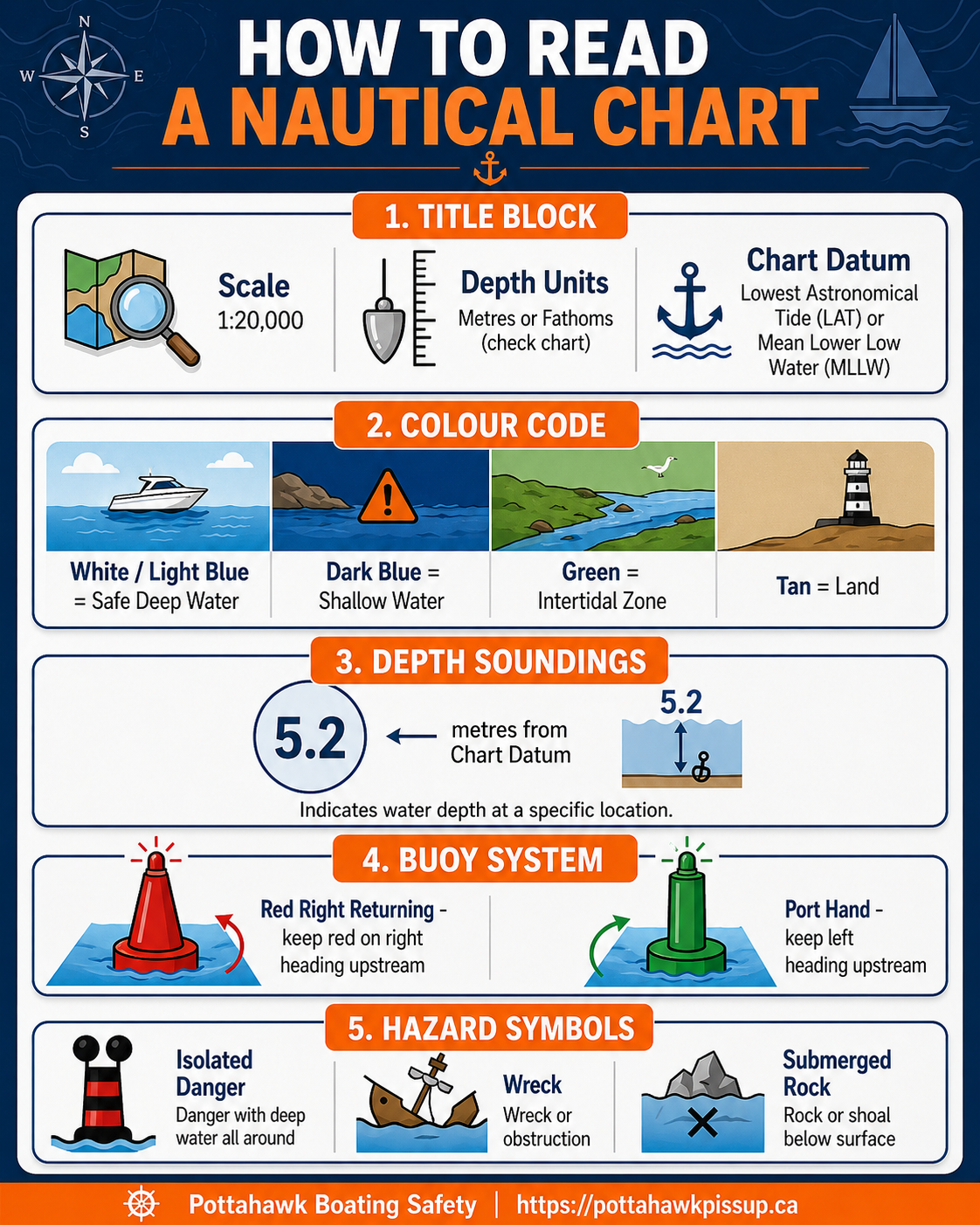
White or Light Blue: This indicates deep water that is generally safe for navigation. When you are cruising in the open waters of Lake Erie, this is where you want to be.
Dark Blue: This colour warns of shallow water. The exact depth that triggers the dark blue shading depends on the chart, but it is a universal signal to slow down, check your depth sounder, and proceed with caution.
Green: Green areas represent intertidal zones—areas that are underwater at high tide but exposed at low tide. While Lake Erie does not have traditional ocean tides, water levels can fluctuate significantly due to wind (a seiche), so treat green areas as land.
Tan or Yellow: This indicates dry land.
Magenta or Purple: This colour is used to highlight important navigational features, such as restricted zones, traffic separation lanes, and the light characteristics of buoys and lighthouses.
Understanding Depth Soundings and Contours
Those numbers scattered all over the water areas of the chart? Those are depth soundings. They tell you the depth of the water at that specific location, measured from the chart datum.
If you see a number like "5," it means the water is 5 units deep (check your title block to see if that is metres or feet). Sometimes you will see a number with a smaller subscript number next to it, like "5₂". On a metric chart, this means 5 metres and 2 decimetres (or 5.2 metres).
You will also notice lines connecting areas of equal depth, similar to the elevation lines on a topographic hiking map. These are called contour lines. They help you visualize the shape of the lakebed. If the contour lines are packed tightly together, it means the bottom drops off steeply. If they are spread far apart, the bottom slopes gently. This is incredibly useful information when you are looking for a good spot to drop anchor or trying to locate a drop-off where fish might be hiding.
The Canadian Buoy System: Red Right Returning
Buoys are the traffic signals of the waterways, and understanding them is non-negotiable. Canada uses the IALA Region B system for its navigational aids. The most important rule to remember in this system is "Red Right Returning."
This means that when you are returning from the open water and heading upstream (or entering a harbour or channel), you must keep the red buoys on your right (starboard) side and the green buoys on your left (port) side.
Here is a quick breakdown of the lateral buoys you will encounter:
Starboard Hand Buoys: These are red, often cone-shaped (nuns), and feature even numbers. Keep them on your right when heading upstream.
Port Hand Buoys: These are green, often cylindrical (cans), and feature odd numbers. Keep them on your left when heading upstream.
Bifurcation Buoys: These mark the point where a channel splits. They have horizontal red and green bands. The colour of the top band tells you the preferred (primary) channel. If the top band is red, treat it like a red buoy and keep it on your right to stay in the main channel.
Spotting Hazards on the Chart
Lake Erie is notorious for its shallow reefs, shifting sandbars, and submerged hazards. Your nautical chart is your best tool for avoiding them.
Look for the isolated danger symbol, which is a black buoy with a horizontal red band. This marks a specific hazard, like a rock or a wreck, that has navigable water all around it. You will also see symbols for shipwrecks (often looking like a sunken hull or a simple cross), rocks that are always underwater (a cross surrounded by dots), and rocks that wash over (an asterisk).
When navigating areas like Long Point Bay, pay close attention to the chart for any notes about shifting sandbars or areas where the depths may have changed since the chart was last updated.
Digital vs. Paper Charts
Today, most boaters rely on digital chartplotters or apps like Navionics. These are fantastic tools. As Garmin explains, digital charts allow you to overlay satellite imagery, view 3D bottom contours, and even see community-sourced data about marinas and hazards.
However, you should never rely solely on electronics. Batteries die, screens overheat in the sun, and GPS signals can occasionally drop. Always carry a current paper chart of your boating area. It does not need batteries, and it gives you a much better "big picture" view of your route than a small digital screen.
Learning to read a nautical chart takes a bit of practice, but it is a skill that pays off every time you leave the dock. It gives you the confidence to explore new anchorages, the knowledge to avoid costly groundings, and the peace of mind that comes from knowing exactly where you are and what lies beneath the surface.
Frequently Asked Questions
What does "Chart Datum" mean on a Canadian nautical chart? Chart Datum is the reference level for all depth soundings on the chart. In Canada, it is typically set to the lowest normal water level. This means the actual water depth is usually greater than the charted depth, providing a margin of safety.
What is the "Red Right Returning" rule? In Canada (which uses the IALA Region B system), "Red Right Returning" means you should keep red buoys on your right (starboard) side and green buoys on your left (port) side when returning from open water or heading upstream into a channel or harbour.
How can I tell if a chart uses metres or feet for depth? You must check the title block of the chart. It will explicitly state whether the depth soundings are measured in metres, feet, or fathoms. Never assume the units, as this can lead to dangerous navigation errors.
What do the different colours on a nautical chart mean? Generally, white or light blue indicates deep, navigable water. Dark blue warns of shallow water. Green indicates intertidal zones (areas exposed at low water), and tan or yellow represents dry land.
Do I still need paper charts if I have a GPS chartplotter? Yes. While digital chartplotters are excellent tools, electronics can fail due to battery issues, overheating, or signal loss. Carrying a current paper chart ensures you always have a reliable backup for safe navigation.
What is the difference between a large-scale and small-scale chart? A large-scale chart covers a small area in great detail, making it ideal for navigating harbours or narrow channels. A small-scale chart covers a large area with less detail, which is better for planning long passages or getting a general overview of a region.
How do I identify a shipwreck on a nautical chart? Shipwrecks are typically marked with a symbol that looks like a sunken hull or a simple cross. The exact symbol can vary depending on whether the wreck is partially visible, always submerged, or considered a hazard to navigation. Always consult the chart's legend or Chart 1 for specific symbol meanings.
What should I do if I encounter an isolated danger buoy? An isolated danger buoy (black with a horizontal red band) marks a specific hazard surrounded by navigable water. You should give this buoy a wide berth and consult your chart to understand the nature and extent of the hazard it marks.
Why is it important to know the chart datum? Knowing the chart datum is crucial because it tells you the reference level for all depth soundings. If you don't know the datum, you can't accurately determine the actual water depth, which could lead to running aground, especially in areas with significant water level fluctuations.
Can I use a nautical chart from another country in Canadian waters? While the basic principles of reading a nautical chart are similar worldwide, it's highly recommended to use official Canadian Hydrographic Service (CHS) charts when navigating Canadian waters. CHS charts are specifically designed for Canadian conditions and adhere to the IALA Region B buoyage system used in Canada.
Sources & Further Reading
Tags
Share
Read Next
 Anchorages & Navigation
Navigating Like a Pro: Canadian Boating Rules, Buoys & Charts
There is a moment every new boater experiences on Lake Erie. You are cruising along, the sun is shining, and the water is relatively calm. Then, you spot a cluster of buoys ahead. One is red, one is green, and another has horizontal stripes.

Dwayne Rodrigues
Boat Owner & Enthusiast
 Anchorages & Navigation
Night Boating on Lake Erie: Real Talk About the Risks
There’s a certain magic to being on the water after the sun goes down. The air cools, the stars pop, and the shoreline transforms into a string of distant, twinkling lights. It feels peaceful, private, almost like you have the whole lake to yourself.
Dwayne Rodrigues
Boat Owner & Enthusiast
 Anchorages & Navigation
Long Point Bay Boater Navigation Guide
Long Point Bay is a boater’s paradise. It’s a place where the wild, unpredictable nature of Lake Erie is tamed by the protective embrace of the Long Point peninsula. For those of us who have spent years navigating these waters, the bay feels like a sanctua
Dwayne Rodrigues
Boat Owner & Enthusiast