The 'Illegal Charter' Trap: Why Charging for a Ride to Pottahawk Can Cost You Everything
The Pottahawk Pissup is a legendary celebration of sun, water, and good times. As we cover in our Pottahawk for Beginners guide, it’s a massive gathering where the boating community comes together for an unforgettable day on Lake Erie.

Dwayne Rodrigues
Boat Owner & Enthusiast
Quick Takeaways
The Line is Clear: If anyone on your boat pays to be there (beyond an equal share of direct costs like fuel), it is legally a commercial "non-pleasure" vessel, not a "pleasure craft."
Insurance Becomes Void: Your standard pleasure craft insurance is immediately voided the moment you operate as an illegal charter. If an accident happens, you are personally liable for all damages, injuries, and legal costs.
Massive Fines: Transport Canada can and does issue fines starting from $6,500 and potentially reaching $250,000 for operating an unlicensed passenger vessel, failing to meet commercial safety standards, and lacking proper certification.
Pottahawk is a Hotspot: Large events like the Pottahawk Pissup are actively monitored for illegal charters. The temptation to run a "water taxi" can lead to severe legal and financial consequences.
The Right Way Exists: If you want a captained experience, use a legitimate, licensed charter company. They have the required commercial insurance, safety equipment, and certified captains to operate legally and safely.
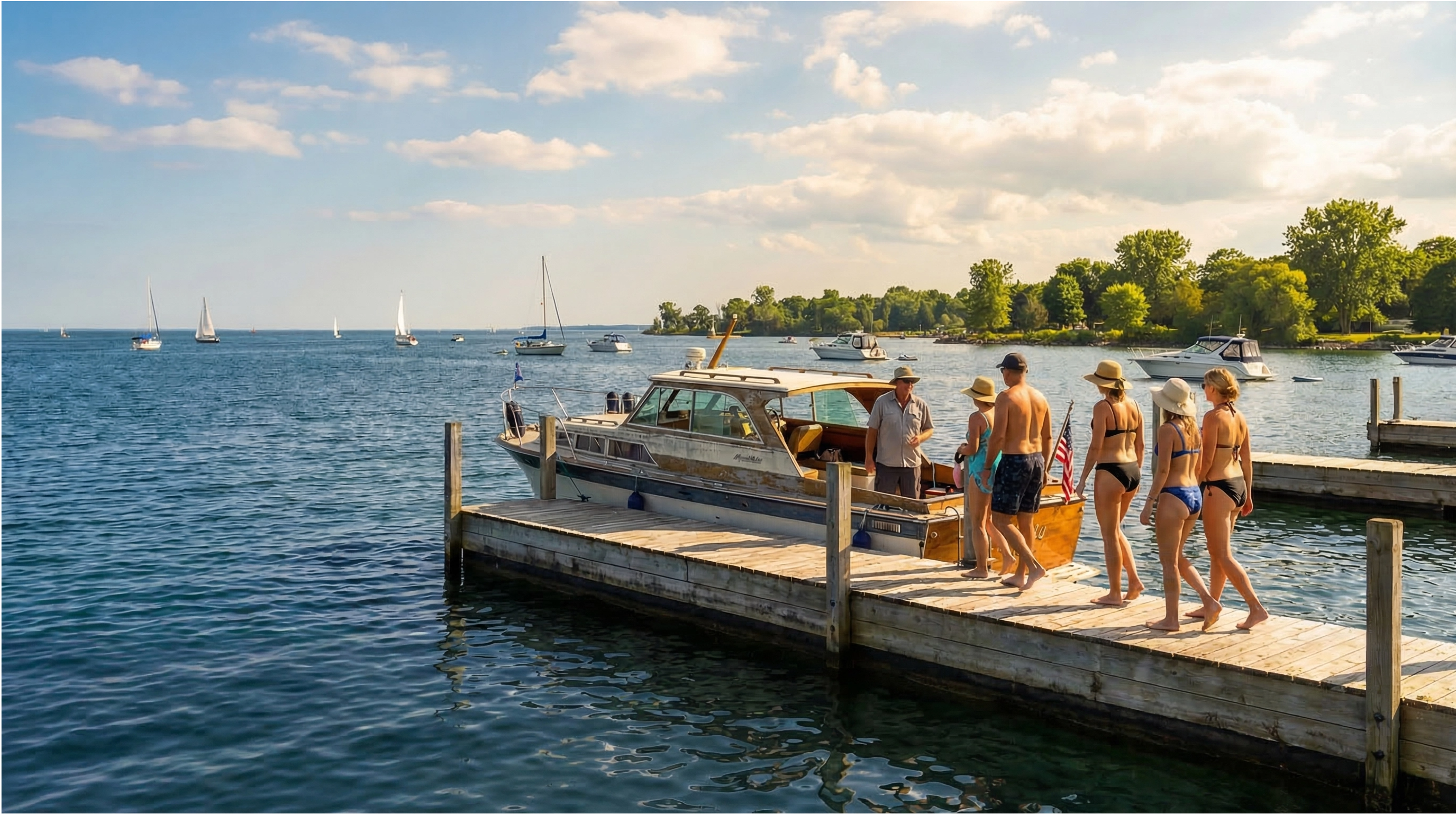
The Pottahawk Pissup is a legendary celebration of sun, water, and good times. As we cover in our Pottahawk for Beginners guide, it’s a massive gathering where the boating community comes together for an unforgettable day on Lake Erie. In the spirit of community, it’s common for boat owners to bring friends, family, and even friends-of-friends along for the ride. But a simple, seemingly harmless act, charging a few bucks for a ride out to the sandbar can land a well-meaning captain in a world of legal and financial ruin.
This is the illegal charter trap. It’s a pitfall that many boaters don’t even know exists, but one that Transport Canada takes incredibly seriously. The moment money changes hands for passage, your private boat is no longer a "pleasure craft" in the eyes of the law. It becomes a commercial passenger vessel, and with that classification comes a mountain of regulations, certifications, and liabilities you are almost certainly not prepared for.
This isn’t just about a slap on the wrist. It’s about voided insurance, life-altering fines, and the personal responsibility for every single person on board. Before you think about running a "Pottahawk water taxi," you need to understand the stark line between sharing a ride and running an illegal operation.
Pleasure Craft vs. Non-Pleasure Craft: The Defining Line
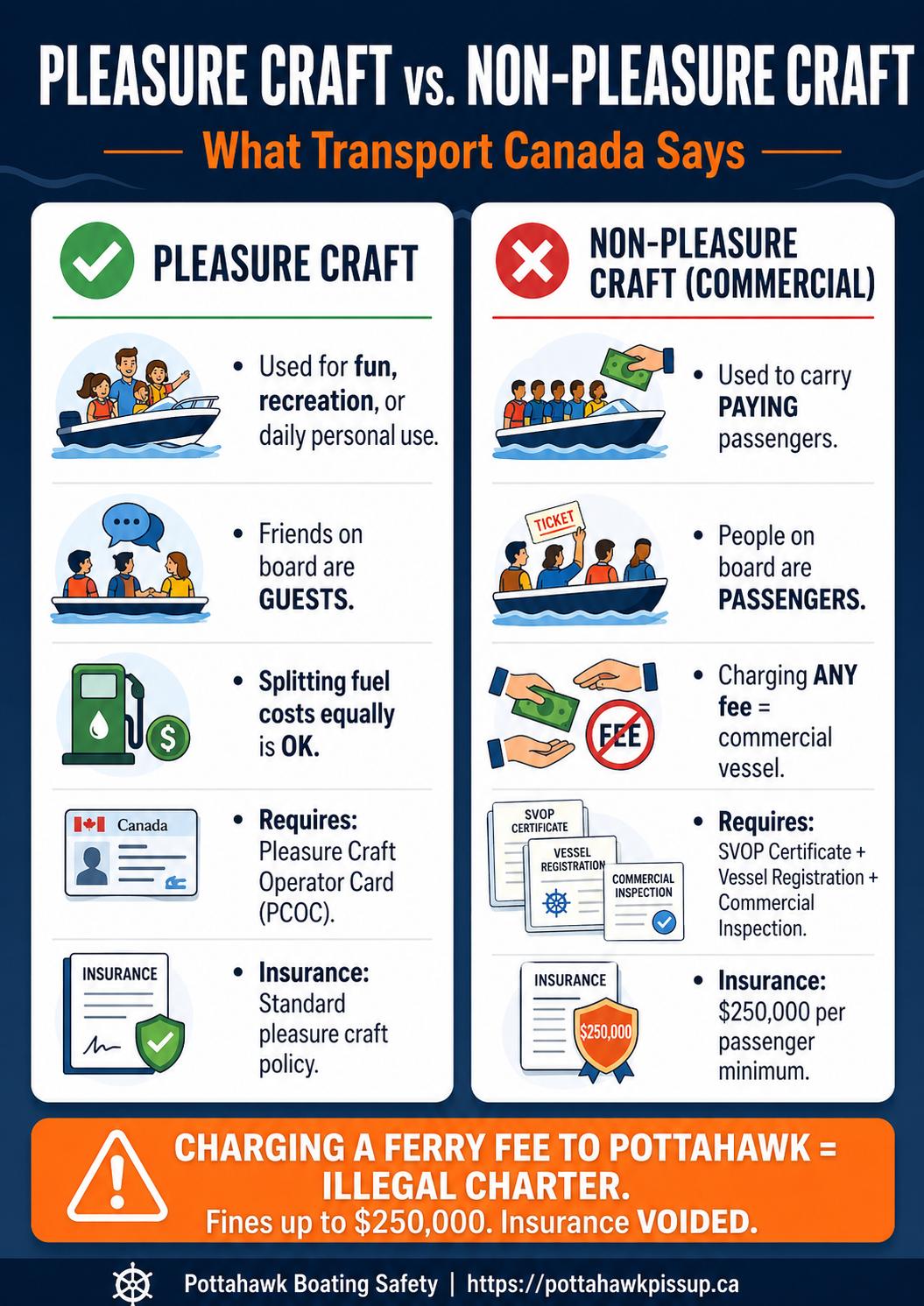
To understand the risk, you first need to understand the two fundamental vessel categories as defined by the Canada Shipping Act, 2001. Your entire legal and insurance framework is built on this distinction.
According to a Ship Safety Bulletin from Transport Canada, the difference is simple and absolute:
A pleasure craft is any vessel used exclusively for pleasure and not for carrying passengers or goods for hire.
This is your typical weekend boat. You use it for cruising, fishing for fun, water sports, and enjoying time with family and friends. A key point from Transport Canada is that friends chipping in for their equal share of the day's fuel does not make it a commercial trip. These individuals are considered "guests."
A non-pleasure craft (often called a commercial vessel) is any vessel used for anything other than pleasure.
This is where the trap springs. The bulletin is crystal clear: if you are using your vessel for activities like guided fishing trips, work, commercial fishing, or carrying passengers for trips or transport, it is a non-pleasure craft. The people on board are no longer "guests"; they are "passengers."
When Does a Guest Become a Passenger?
The second someone pays you a fee to be on your boat, they legally become a passenger. It doesn’t matter if you call it a "ferry fee," a "contribution," or just "gas money" if it exceeds their direct share. If you, the owner, are making a profit or are being compensated for providing transportation, you are running a passenger vessel.
Transport Canada provides a critical example: if you rent or charter a vessel and are told you must hire a captain provided by the owner (or from a pre-approved list), you are a passenger on a non-pleasure craft. The owner has operational control, and it is a commercial transaction. This same logic applies if you are the owner and you are providing the captaincy as part of the paid ride.
The Consequences: Why It's Not Worth the Risk
Thinking you can make a few hundred dollars running trips to Pottahawk might seem tempting. But the potential costs can be catastrophic. The risks fall into two main categories: financial and legal.
Your Insurance is Immediately Void
This is the single most critical financial risk. Every standard pleasure craft insurance policy contains a "private pleasure use" warranty. This clause explicitly states that the boat will be used solely for private pleasure purposes and will not be chartered, leased, or used for any commercial purpose.
As legal experts at Harper Grey LLP explain in a case review, using a boat for commercial purposes when it is insured for private use will void the contract. This isn’t a grey area; it’s an absolute warranty. The moment you accept money for a ride, your insurance coverage ceases to exist.
Imagine this scenario: you take on a group of paying passengers for a trip to the Pottahawk sandbar. On the way, a wave causes a passenger to fall and suffer a serious injury. Or, a mechanical failure leads to a fire, and your boat is a total loss. Because you were engaged in commercial activity, your insurer will deny your claim. You are now personally and solely responsible for:
The full cost of replacing your boat.
The medical bills and potential lifetime care costs for the injured passenger.
All legal fees, both for your defence and for any lawsuits brought against you.
What started as a way to make a little cash has now jeopardized your home, your savings, and your entire financial future.
The Crushing Weight of Transport Canada Fines
Transport Canada’s enforcement division, the Small Vessel Compliance Program, actively investigates and prosecutes illegal charters. They don’t take kindly to operators who put the public at risk by skirting safety regulations.
In a 2021 press release, Transport Canada detailed the consequences of an illegal charter that led to a fatality on Lake Simcoe. The operator was fined a total of $6,500 for a list of violations under the Canada Shipping Act, 2001, including:
Operating a vessel without the proper certificate of competency.
Failing to ensure the vessel and its equipment complied with regulations.
Failing to establish emergency safety procedures.
Failing to provide passengers with safety briefings.
Taking actions that could jeopardize the safety of the vessel or passengers.
And those fines can go much, much higher. Recent amendments to the regulations have increased the maximum penalty amount to $250,000 to strengthen the financial deterrent. This isn't a parking ticket; it's a life-altering penalty designed to stop illegal operators in their tracks.
The Safety Gap: What Commercial Vessels Have That You Don't
The reason the rules are so strict is that commercial passenger vessels are held to a much higher safety standard. This isn't just red tape; it's a system designed to protect lives. When you operate illegally, you are bypassing a comprehensive safety net that our Lake Erie Boating Safety Guide emphasizes for all boaters.
Safety Requirement | Pleasure Craft (Minimum) | Commercial Passenger Vessel (Mandatory) |
|---|---|---|
Vessel Registration | Pleasure Craft Licence | Canadian Register of Vessels (detailed inspection) |
Construction Standards | Basic safety standards | Strict construction and stability standards |
Safety Equipment | Basic required gear (lifejackets, flares, etc.) | Enhanced equipment: liferafts, EPIRBs, extensive first aid kits |
Captain's Certification | Pleasure Craft Operator Card (PCOC) | Small Vessel Operator Proficiency (SVOP), Marine Emergency Duties (MED) |
Safety Procedures | Recommended | Written, documented, and drilled emergency procedures |
Passenger Briefings | Recommended | Mandatory, detailed pre-departure safety briefings |
Insurance | Pleasure Craft Liability | Commercial Marine Liability ($250,000 per passenger minimum) |
As you can see, the gap is enormous. A PCOC is not a commercial license. Having the basic safety gear is not the same as having a commercially-inspected vessel. Your responsibility as a captain shifts dramatically from being a host for guests to being a commercial operator responsible for the lives of paying passengers. This is a legal and ethical duty that requires proper training, equipment, and certification, all things an illegal charter operator lacks.
The Pottahawk Pissup: A High-Risk Environment
Large, high-energy events like Pottahawk create the perfect storm for the illegal charter trap. You have a huge demand for rides, a surplus of private boats, and a party atmosphere where safety can take a backseat. This is precisely why Transport Canada and other enforcement agencies increase their patrols during these events, which is a key reason we published our guide on how to safely attend large boat raft-ups.
They are actively looking for signs of illegal charters:
Boats making repeated trips back and forth from shore.
Overloaded vessels.
Operators who appear to be collecting money on the dock or on the boat.
Online ads on social media or marketplace sites offering "boat rides to Pottahawk."
Don't think it can't happen to you. Every year, operators are caught and fined. The allure of easy money quickly fades when you are facing a voided insurance policy and a six-figure fine.
Do It the Right Way: Support Legal Charters
This isn't to say you can't get a ride to Pottahawk if you don't have a boat. There is a safe, legal, and responsible way to do it: hire a licensed charter company.
Legitimate charter operators have done the work. They have:
Registered their vessels as commercial with Transport Canada.
Passed rigorous safety inspections.
Invested in commercial-grade safety equipment.
Obtained the proper commercial liability insurance.
Ensured their captains hold commercial licences like the SVOP and MED certificates.
By choosing a legal charter, you are not only ensuring your own safety but also supporting the professional operators who respect the rules and invest in the well-being of their passengers. Our new Boat Rentals & Charters Directory is being built to connect you with these trusted, compliant operators in the Lake Erie region.
For boat owners, the message is simple: enjoy the day, bring your friends, and share the adventure. But the moment you put a price tag on a seat, you cross a line that you cannot afford to cross. Protect your investment, your financial future, and the safety of everyone on the water. Keep it a pleasure craft.
Sources & Further Reading
Transport Canada Ship Safety Bulletin SSB No.: 19/2024 - The definitive guide on pleasure vs. non-pleasure craft.
Transport Canada News Release (July 2021) - Details on fines issued for a fatal illegal charter incident.
Harper Grey LLP: "Using a boat for commercial purposes when it is insured for private use will void the contract" - Legal analysis of insurance implications.
Canada Shipping Act, 2001 - The primary legislation governing vessel operation in Canada.
Tags
Share
Read Next
 Safety
Marine Emergencies: A Complete Guide to On-Water Incidents
There is a moment every boater dreads. You are cruising along, enjoying the sun and the water, when suddenly the engine cuts out, smoke starts billowing from the hatch, or someone slips and falls over the rail. In that split second, the peaceful day on the

Dwayne Rodrigues
Boat Owner & Enthusiast
 Safety
Do You Need a Boating Licence in Canada?
If you are planning to spend any time on the water this summer, you have probably asked yourself the big question: do you need a boating licence in Canada? The short answer is yes. If your boat has a motor, you need a licence.
Dwayne Rodrigues
Boat Owner & Enthusiast
 Safety
How to Avoid Running Aground: A Boater's Guide to Shallow Water Safety
Running aground is one of those boating experiences that ranges from a minor, face-reddening embarrassment to a catastrophic emergency. One minute you are cruising along enjoying the sun, and the next, there is a sickening crunch, a sudden stop, and every
Dwayne Rodrigues
Boat Owner & Enthusiast