Marine Emergencies: A Complete Guide to On-Water Incidents
There is a moment every boater dreads. You are cruising along, enjoying the sun and the water, when suddenly the engine cuts out, smoke starts billowing from the hatch, or someone slips and falls over the rail. In that split second, the peaceful day on the

Dwayne Rodrigues
Boat Owner & Enthusiast
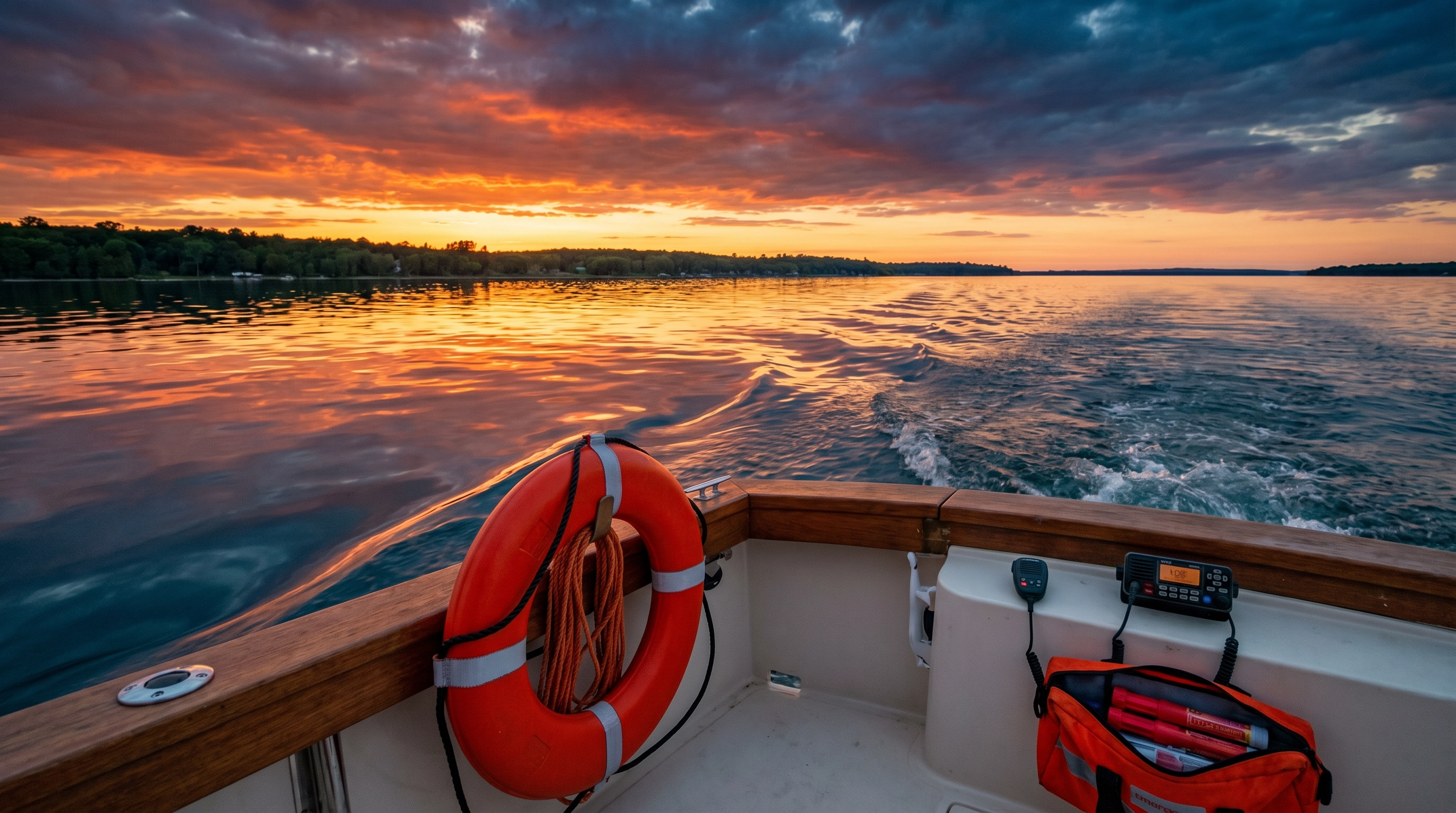
There is a moment every boater dreads. You are cruising along, enjoying the sun and the water, when suddenly the engine cuts out, smoke starts billowing from the hatch, or someone slips and falls over the rail. In that split second, the peaceful day on the water vanishes, and you are thrust into a marine emergency.
When things go wrong on the water, they go wrong fast. You cannot simply pull over to the shoulder and wait for a tow truck. You are entirely self-reliant until help arrives, and the decisions you make in those first few minutes will dictate the outcome of the situation.
Whether you are navigating the unpredictable waters of Lake Erie or cruising a quiet inland lake, knowing exactly how to respond to an on-water incident is the most important skill you can possess as a captain. This guide covers the critical procedures for the most common marine emergencies, from making a proper Mayday call to executing a man overboard rescue, fighting a boat fire, and surviving cold water immersion.
The Foundation of Emergency Response
Before we dive into specific scenarios, we need to establish the foundation of all marine emergency responses. The very first thing you must do in any crisis is stop the boat. Pull the throttle back to neutral immediately. This prevents you from driving further into danger, stops the propeller from injuring anyone in the water, and gives you a moment to assess the situation.
Once the boat is stopped, your next priority is life jackets. If your crew is not already wearing them, every single person on board must put on a Personal Flotation Device (PFD) immediately. Do not wait to see if the situation worsens. If you are taking on water, fighting a fire, or dealing with a severe weather event, getting those life jackets on is your absolute top priority.
Finally, you need to know your exact location. If you have to call for help, the Canadian Coast Guard cannot assist you if they do not know where you are. Check your chartplotter, note your GPS coordinates, or identify your position relative to a known landmark or navigation buoy.
How to Call for Help: Mayday vs. Pan-Pan
When you need assistance on the water, your VHF marine radio is your lifeline. While cell phones are useful, they rely on cell towers that often lose signal offshore, and they only connect you to one person at a time. A VHF radio broadcasts your distress call to the Coast Guard and every other vessel in your vicinity, which means a nearby boater might reach you long before official rescue assets arrive.
There are two primary types of emergency radio calls you need to know: the Mayday call and the Pan-Pan call. Understanding the difference between the two is critical.
The Mayday Call
A Mayday call is reserved exclusively for situations involving grave and imminent danger to life or the vessel. You only use a Mayday when you need immediate, life-saving assistance. Examples include a boat fire you cannot control, rapidly taking on water and sinking, or a medical emergency where someone has stopped breathing.
To issue a Mayday call, tune your VHF radio to Channel 16 and follow this exact script provided by the Canadian Coast Guard:
Say "MAYDAY, MAYDAY, MAYDAY"
Say "THIS IS" followed by your vessel name three times
Say "MAYDAY" and your vessel name once more
Give your exact position (GPS coordinates or clear landmarks)
State the nature of your distress (e.g., "We are taking on water and sinking")
State the kind of assistance you need
Provide the number of people on board and any other useful information
Say "OVER" and wait for a response
If you do not receive a response after a few moments, repeat the entire message.
The Pan-Pan Call
A Pan-Pan call (pronounced "pahn-pahn") is an urgency signal. It indicates that you have a serious situation that requires assistance, but there is no immediate, life-threatening danger. Examples include a total engine failure while drifting toward a rocky shore, a medical issue that requires attention but is not immediately fatal, or a slow leak that your bilge pump is currently managing.
The structure of a Pan-Pan call is similar to a Mayday:
Say "PAN-PAN, PAN-PAN, PAN-PAN"
Say "ALL STATIONS, ALL STATIONS, ALL STATIONS"
Say "THIS IS" followed by your vessel name three times
Give your position, the nature of your problem, and the assistance required
Say "OVER"
If your situation deteriorates after issuing a Pan-Pan, you can escalate it to a full Mayday call.
Man Overboard (MOB) Procedures
A man overboard is one of the most terrifying emergencies you can face, and it is consistently a leading cause of boating fatalities in Canada. When someone falls into the water, especially the cold waters of the Great Lakes, you have a very narrow window of time to execute a successful rescue.
According to Transport Canada, the official procedure for a man overboard involves several critical steps that must happen simultaneously.
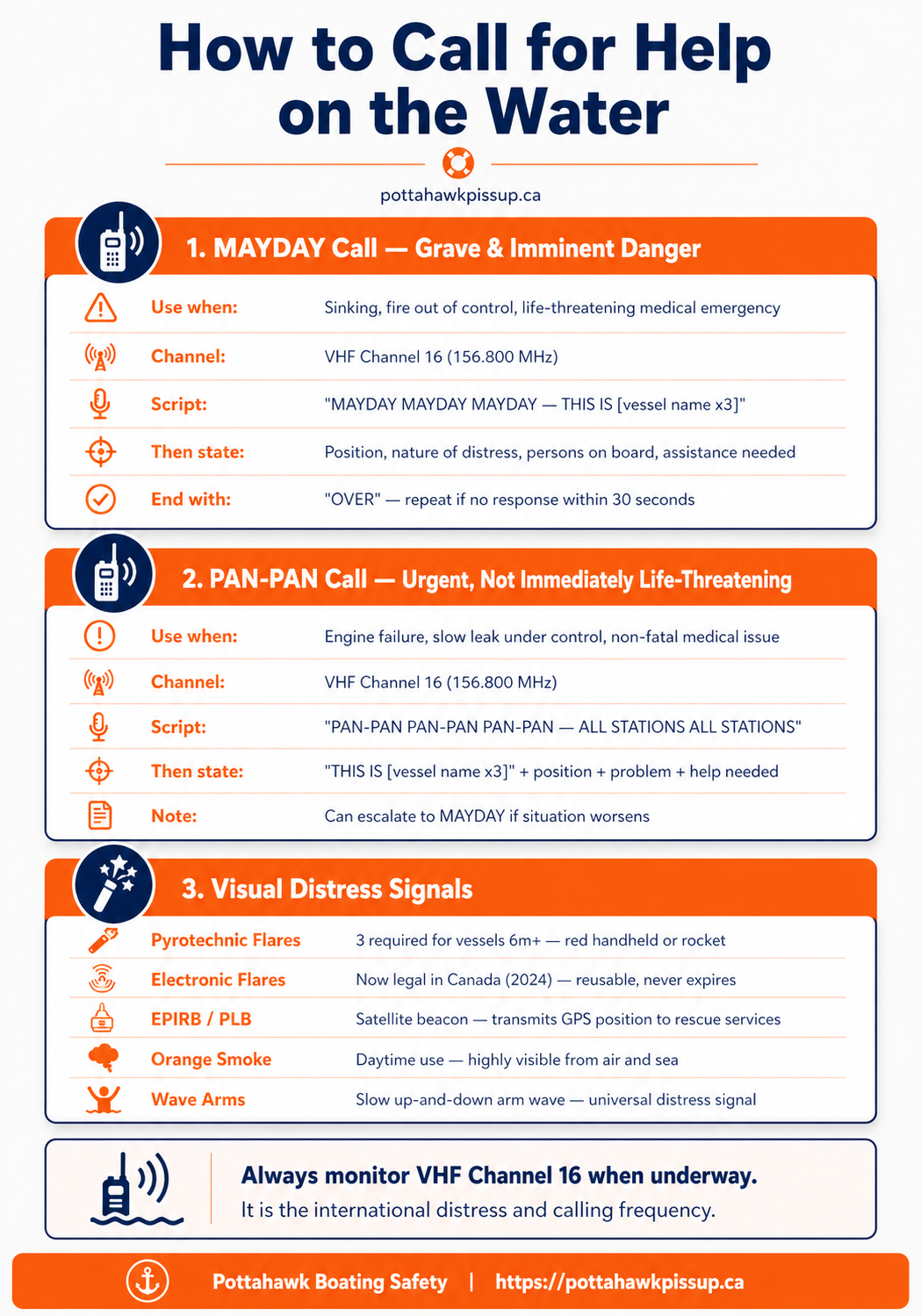
The moment someone falls in, the first person to see it must shout "Man Overboard!" at the top of their lungs and point directly at the victim. This person becomes the designated spotter. Their only job is to keep their eyes locked on the person in the water and continue pointing at them. In rough water or fading light, a person's head is incredibly difficult to spot, and if you lose sight of them, finding them again can be nearly impossible.
Immediately throw something that floats toward the victim. A life ring, a buoyant heaving line, a boat cushion, or even a cooler, anything that will give them extra buoyancy and mark their location in the water.
The captain must immediately turn the steering wheel toward the side the person fell over. This swings the stern, and the dangerous spinning propeller, away from the victim.
To retrieve the person, make a slow, powered approach from downwind (heading into the wind). This gives you the most control over the boat and prevents the wind from blowing the vessel over the top of the victim. As you get close, shift into neutral. Once you have a hold of the person or they have grabbed the swim platform, you must kill the engine completely. Never leave the engine running when someone is boarding from the water near the stern.
Surviving Cold Water Immersion
If you boat on Lake Erie or any of the Great Lakes, you must respect the temperature of the water. As we detail in our guide to cold water boating risks, cold water is an unseen killer that incapacitates victims long before hypothermia sets in.
When you fall into cold water, your body experiences cold shock. This triggers an involuntary gasp reflex, which often causes victims to inhale water and drown immediately. This is followed by hyperventilation and a massive spike in heart rate and blood pressure.
If you survive the initial cold shock, you have about 10 minutes of meaningful movement before cold incapacitation sets in. Your body pulls blood away from your extremities to protect your core organs, leaving your arms and legs useless. You will lose the ability to swim, tread water, or even hold onto a rescue line. This is why wearing a life jacket is non-negotiable, once your muscles fail, the PFD is the only thing keeping your head above the surface.
If you are stranded in cold water, do not try to swim for shore unless it is very close. Swimming accelerates heat loss. Instead, assume the HELP (Heat Escape Lessening Position). Bring your knees up to your chest, cross your arms over your chest, and stay as still as possible. If there are multiple people in the water, huddle together tightly to share body heat.
Fighting a Boat Fire
A fire on a boat is a nightmare scenario because you are surrounded by water but have nowhere to run. Boats are packed with highly flammable materials, including fuel, oil, fiberglass, and electrical wiring.
If a fire breaks out, the first step is to stop the engine and position the boat so the wind blows the fire and smoke away from the vessel, not across the deck. If the fire is in the engine compartment, do not open the engine hatch. Opening the hatch introduces a massive rush of oxygen that will cause the fire to flare up violently. Instead, discharge your fire extinguisher through the dedicated access port.
For fires outside the engine compartment, Transport Canada recommends using the PASS technique with your marine fire extinguisher:
Pull the pin on the extinguisher.
Aim the nozzle at the base of the fire, not the flames.
Squeeze the handle.
Sweep from side to side, covering the entire base of the fire.
Always keep your back to an exit so you are not trapped if the fire spreads. If the fire is generating thick toxic smoke, is near the fuel tanks, or is too large for your extinguisher, you must abandon ship. Get everyone into their life jackets, issue a Mayday call, and get off the boat.
Flooding and Taking on Water
Discovering that your boat is taking on water is a heart-stopping moment. The key to surviving a flooding emergency is finding the source of the leak quickly and managing the water level while you head for safety.
First, turn on your bilge pump manually. Do not rely on the automatic float switch. If the water is rising faster than the bilge pump can handle, get your crew to start bailing with buckets, cut-off milk jugs, or the manual bailer required by Transport Canada boating rules.
Next, locate the leak. Check the most common culprits: a blown cooling water hose, a failed through-hull fitting, a loose drain plug, or a cracked transducer. If you find a hole or a broken fitting, shove anything you can into it to slow the flow of water. Rags, towels, wooden bungs, or even a life jacket can be wedged into a breach to buy you time.
If the leak is on one side of the hull, shift your passengers and heavy gear to the opposite side. This heels the boat over and may raise the hole above the waterline, stopping the flooding entirely.
If you cannot control the water and the boat is in danger of sinking, issue a Mayday call immediately. Ensure everyone is wearing a life jacket and prepare to abandon ship. Remember that most modern recreational boats have built-in flotation and will not sink completely to the bottom, even when swamped. Stay with the boat if it remains afloat, as a swamped hull is much easier for rescuers to spot than a single person bobbing in the waves.
Running Aground
Lake Erie is notorious for its shifting sandbars and shallow shoals, especially around Long Point Bay. As we cover in our guide on how to avoid running aground, hitting the bottom is a common occurrence, but how you react determines whether it is a minor inconvenience or a major emergency.
If you feel the sickening crunch of the hull hitting the bottom, pull the throttle to neutral immediately. Do not try to power your way over the shoal, as this will only drive you further onto the hazard and likely destroy your propeller or outdrive.
Once stopped, check the bilge immediately. You need to know if the impact breached the hull and you are taking on water. If the hull is intact, assess your situation. Check the water depth around the boat using a boat hook or paddle.
If you are only lightly grounded, you may be able to back off the way you came. Shift your passengers to the side of the boat facing deeper water to lift the grounded section of the hull, and apply gentle reverse power. If you are firmly stuck, do not burn out your engine trying to reverse. Set an anchor to prevent the wind or current from pushing you further aground, and call for a commercial towing service.
Essential Emergency Equipment
You cannot manage a marine emergency if you do not have the right tools on board. While Transport Canada mandates a minimum list of safety gear, relying only on the bare minimum is a mistake. A well-prepared captain carries equipment designed to handle worst-case scenarios.
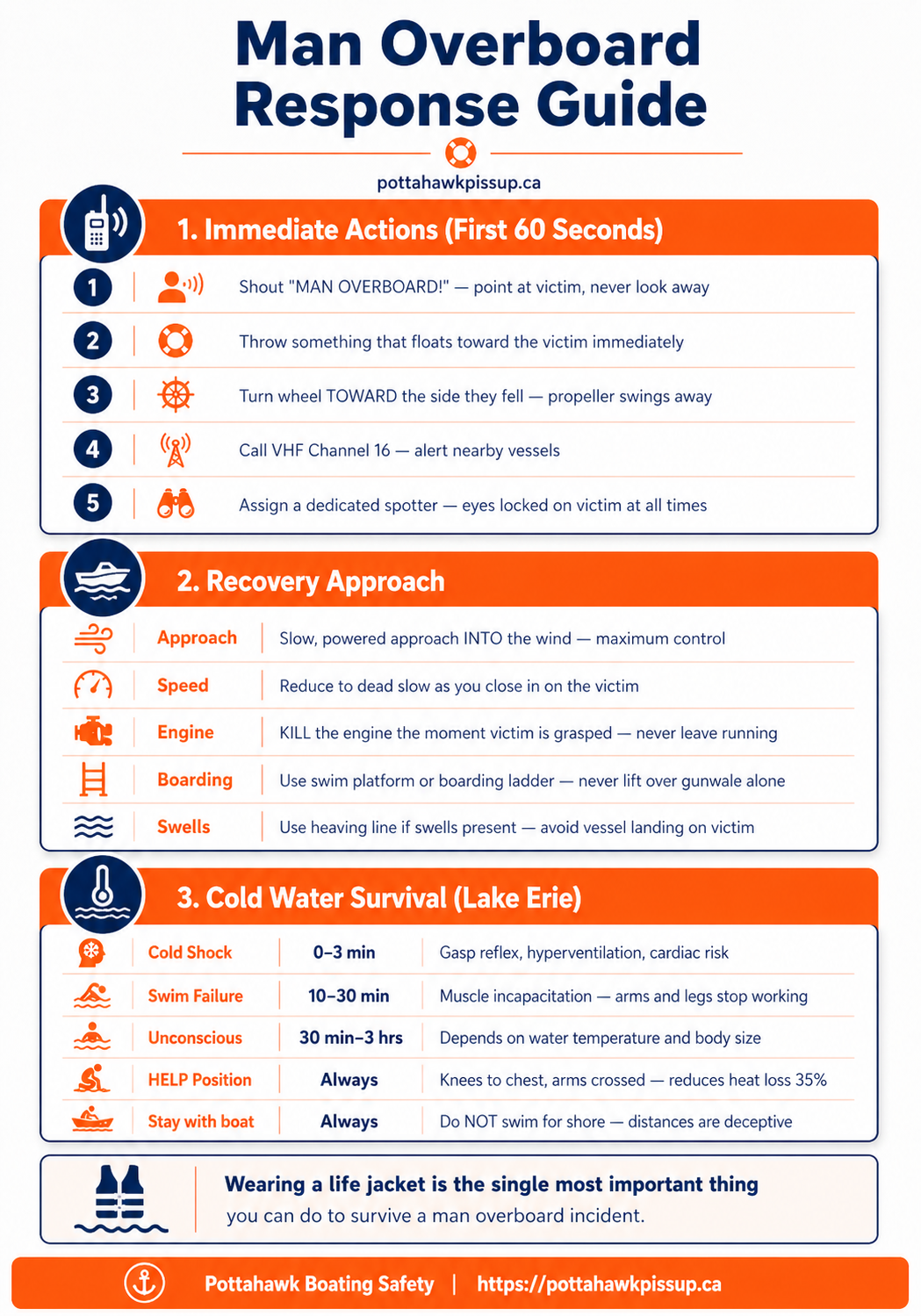
Your emergency kit should start with reliable communication. A fixed-mount VHF radio is essential, but a handheld waterproof VHF is a vital backup if your boat loses electrical power. For offshore trips, consider an EPIRB (Emergency Position Indicating Radio Beacon) or a PLB (Personal Locator Beacon). When activated, these devices transmit your exact GPS coordinates to search and rescue satellites, guaranteeing that help will find you even if your radio is dead.
Visual distress signals are also critical. While traditional pyrotechnic flares are standard, electronic boat flares are now legal in Canada and offer a safer, reusable alternative that never expires. You should also carry a high-quality first aid kit, a heavy-duty manual bilge pump, wooden bungs for plugging through-hull leaks, and a sharp knife accessible near the helm for cutting tangled lines.
For a complete breakdown of the gear you need, review our comprehensive boat safety equipment checklist.
The Role of Insurance in an Emergency
It is worth noting that how you handle an emergency can have significant implications for your boat insurance. While your primary focus must always be on saving lives, your secondary responsibility is mitigating damage to the vessel.
If you run aground and destroy your engine trying to power off the shoal, your insurance provider may deny the claim, arguing that you caused the mechanical damage through negligence after the initial grounding. Similarly, if you abandon a vessel that could have been saved, or fail to deploy an anchor to prevent a disabled boat from washing onto the rocks, you may face complications during the claims process.
Always prioritize human safety, but once your crew is secure, take reasonable steps to protect the boat. Document the incident as soon as you are safely back on land, and contact your insurance provider promptly.
Preparation is the Ultimate Safety Gear
Marine emergencies are chaotic, loud, and terrifying. When the adrenaline hits, you will not have time to read a manual or look up a YouTube tutorial. You will fall back on your training and your preparation.
The best captains do not just buy safety gear; they practice using it. They run man overboard drills with a floating cushion. They teach their regular passengers how to use the VHF radio to make a Mayday call. They know exactly where the fire extinguisher is mounted and how to access the engine port.
Boating is an incredible privilege, but it demands respect. By understanding these emergency procedures and preparing your vessel and your crew, you ensure that when the unexpected happens, you have the knowledge and the tools to bring everyone home safely.
Medical Emergencies on the Water
While mechanical failures and environmental hazards make up a large portion of marine emergencies, medical crises are equally dangerous. A heart attack, a severe allergic reaction, or a traumatic injury from a fall or propeller strike requires immediate action. When you are miles offshore, an ambulance cannot reach you, and you must act as the first responder.
If a medical emergency occurs, your first step is to stabilize the patient using your onboard first aid kit. If the situation is life-threatening—such as cardiac arrest, severe arterial bleeding, or anaphylaxis—issue a Mayday call immediately. If the situation is serious but not immediately fatal, such as a broken bone or a deep laceration that is under control, issue a Pan-Pan call.
When communicating with the Coast Guard during a medical emergency, they can connect you with a MEDICO service. This service patches you through to a doctor who can provide step-by-step medical advice over the radio while rescue assets are dispatched.
While waiting for help, or if you are instructed to head to the nearest port, ensure the patient is as comfortable as possible. Keep them warm to prevent shock, and assign a dedicated crew member to monitor their breathing and consciousness continuously. Knowing the exact location of the nearest marina or public dock is critical, as the Coast Guard may instruct you to meet an ambulance there rather than attempting an on-water transfer, which can be dangerous in rough conditions.
Capsizing and Swamping
Capsizing (when a boat turns over) and swamping (when a boat fills with water but remains upright) are catastrophic events that often happen suddenly due to severe weather, overloading, or taking a large wave over the stern or beam.
If your boat capsizes or swamps, the most important rule is to stay with the boat. Modern recreational vessels under 6 metres (20 feet) are required by Transport Canada to have built-in level flotation, meaning they will not sink completely even when full of water. A swamped boat provides a large, visible target for search and rescue teams, whereas a single person swimming in the water is nearly impossible to spot from the air or a distance.
Immediately ensure everyone is wearing a life jacket. If the boat is upside down, try to climb onto the overturned hull to get as much of your body out of the cold water as possible. Do not attempt to swim to shore unless it is extremely close and you are absolutely certain you can make it. Distances over water are highly deceptive, and cold water incapacitation will set in long before you reach land.
If you have access to your emergency signaling devices, use them. A waterproof handheld VHF radio attached to your life jacket is invaluable in this scenario. If you only have visual signals, wait until you see a potential rescue vessel or aircraft before deploying flares or smoke signals to ensure they are seen.
Towing and Being Towed
Eventually, almost every boater will either need a tow or be asked to provide one. While it may seem like a simple favor, towing another vessel is a complex and potentially dangerous operation that can quickly turn into an emergency if done incorrectly.
If you are disabled and need a tow, your first call should be to a professional marine towing service if one operates in your area. They have the proper equipment, training, and insurance to handle the job safely. If a professional is not available and another boater offers to help, you must proceed with extreme caution.
When setting up a tow, never attach the tow line to a deck cleat that is not backed with a heavy backing plate. Standard cleats can rip out of the fiberglass under the immense strain of towing, turning the cleat into a lethal projectile. The tow line should be attached to the bow eye (the heavy U-bolt used for winching the boat onto a trailer) on the disabled vessel, and to the stern ski tow eyes or a dedicated towing bridle on the towing vessel.
Use a long, heavy-duty line preferably nylon, which has some stretch to absorb shock loads. Keep the speed very slow, and ensure all passengers on both boats are wearing life jackets and are seated well away from the tow line. If the line snaps, it will whip back with incredible force. Always have a sharp knife ready to cut the line instantly if the towed vessel begins to yaw violently or if the towing vessel is pulled off course.
The Psychology of an Emergency
Beyond the physical procedures and the equipment, surviving a marine emergency requires managing the psychological impact of the crisis. Panic is contagious, and as the captain, your crew will look to you for cues on how to react.
If you lose your composure, your passengers will panic, making the situation infinitely more difficult to manage. You must project calm, decisive leadership, even if you are terrified internally.
Take a deep breath. Stop the boat. Assess the situation. Delegate tasks clearly and directly. Instead of yelling "Somebody grab the fire extinguisher!", point to a specific person and say, "John, get the fire extinguisher from under the helm and bring it here." Clear, direct communication cuts through the chaos and gives terrified passengers a specific focus, which helps reduce their panic.
Conclusion: The Captain's Ultimate Responsibility
When you take the helm of a vessel, you accept the ultimate responsibility for the lives of everyone on board. The water is an unforgiving environment that does not care about your experience level or the price of your boat.
Marine emergencies are rare, but they are an inherent risk of boating. By understanding the procedures for man overboard, fire, flooding, and medical crises, and by equipping your vessel with the proper safety and communication gear, you transform yourself from a passenger into a true captain.
Review these procedures at the start of every season. Brief your crew before you leave the dock. Respect the water, prepare for the worst, and you will ensure that every trip ends safely back at the marina.
Sources & Further Reading
Tags
Share
Read Next
 Safety
Do You Need a Boating Licence in Canada?
If you are planning to spend any time on the water this summer, you have probably asked yourself the big question: do you need a boating licence in Canada? The short answer is yes. If your boat has a motor, you need a licence.

Dwayne Rodrigues
Boat Owner & Enthusiast
 Safety
How to Avoid Running Aground: A Boater's Guide to Shallow Water Safety
Running aground is one of those boating experiences that ranges from a minor, face-reddening embarrassment to a catastrophic emergency. One minute you are cruising along enjoying the sun, and the next, there is a sickening crunch, a sudden stop, and every
Dwayne Rodrigues
Boat Owner & Enthusiast
 Safety
"The Unseen Killer: Why Cold Water Boating on the Great Lakes Demands Your Full Respect"
It is a perfect spring day on Lake Erie. The sun is out, the air feels warm for the first time in months, and the water looks deceptively calm. It feels like summer, but it is not. Beneath that placid surface, the water is a chilling 7 degrees Celsius
Dwayne Rodrigues
Boat Owner & Enthusiast