Beginner's Guide to Boating in Canada
So, you’re thinking about getting into boating in Canada. Fantastic. You’re about to join millions of Canadians who take to our incredible lakes, rivers, and coastlines every year. It’s a world of breathtaking sunsets, unforgettable family moments, and the

Dwayne Rodrigues
Boat Owner & Enthusiast
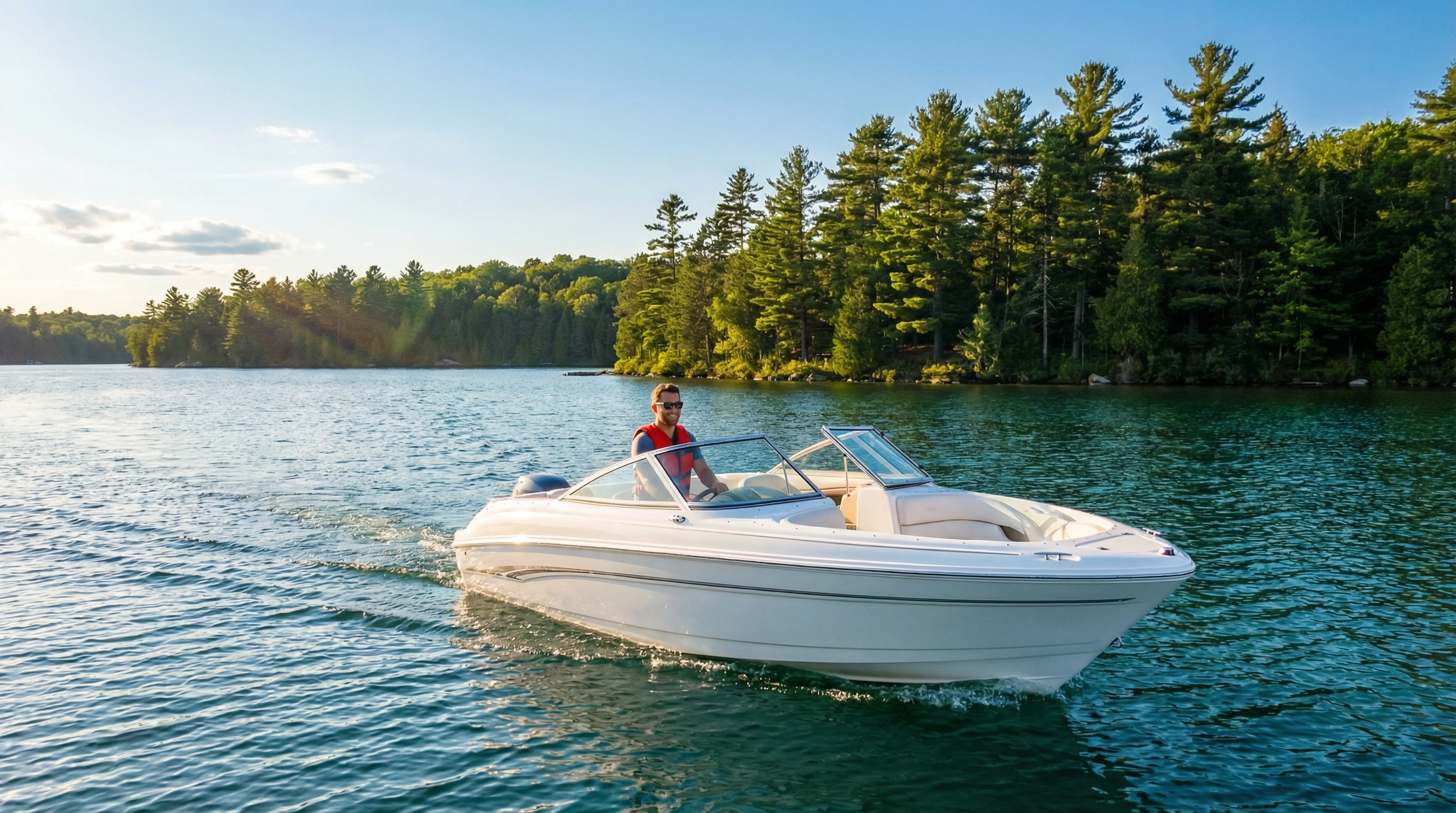
So, you’re thinking about getting into boating in Canada. Fantastic!,a you’re about to join millions of Canadians who take to our incredible lakes, rivers, and coastlines every year. It’s a world of breathtaking sunsets, unforgettable family moments, and the kind of freedom you can only find on the water. But before you cast off the lines and picture yourself cruising across Lake Erie, there are a few essential things you need to know. Getting started isn’t complicated, but it does require a bit of preparation to do it safely and legally.
This guide is your comprehensive starting point. We’re going to walk you through everything, step-by-step, from the licences you need to the gear you have to carry. Think of this as your roadmap from the dock to open water.
Quick Takeaways
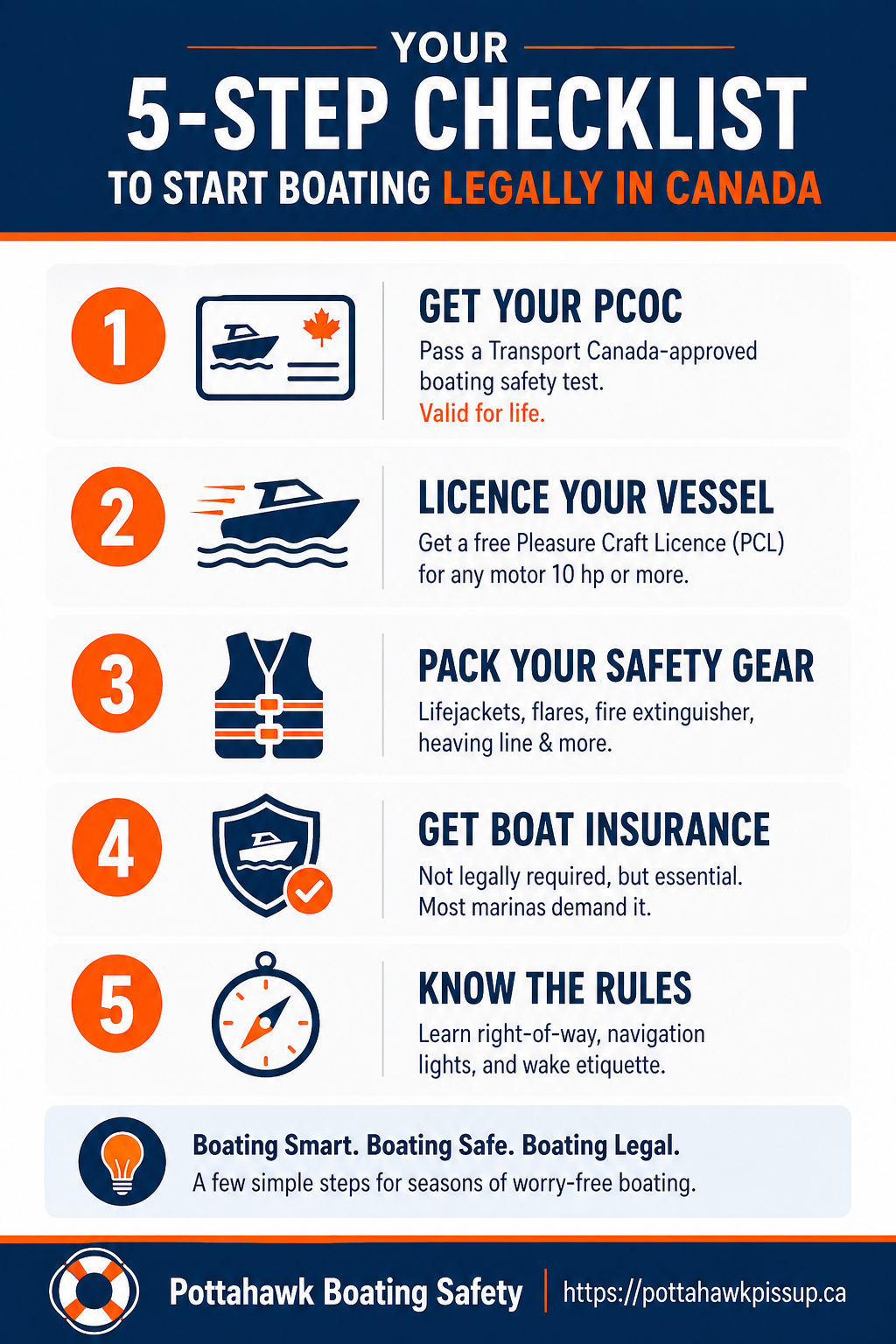
Get Your Card: Every operator of a motorized boat in Canada needs a Pleasure Craft Operator Card (PCOC). It’s a one-time certification you get by passing a test.
Licence Your Boat: If your boat has a motor of 10 hp (7.5 kW) or more, it needs a Pleasure Craft Licence (PCL). This is a free, 10-year licence from Transport Canada that links your boat to you.
Carry Your Gear: You are legally required to carry specific safety equipment on board, from lifejackets for everyone to flares and a fire extinguisher. The requirements vary by boat size.
Get Insured: While not legally mandatory everywhere, boat insurance is essential. Most marinas require it, and it protects you from liability and damage.
Know the Rules: Just like driving a car, boating has its own set of rules for navigation, right-of-way, and safety. Understanding them is non-negotiable.
The Single Most Important Document: Your Pleasure Craft Operator Card (PCOC)
Let’s start with the absolute must-have. If you’re going to be at the helm of any motorized boat in Canada, you need what’s called a Pleasure Craft Operator Card, or PCOC. It’s often called a “boating licence,” and for all intents and purposes, that’s what it is, proof that you have the minimum required knowledge to operate a boat safely.
According to Transport Canada, this applies to operators of all pleasure craft fitted with any type of motor, and that includes small electric trolling motors. Even if you’re on a sailboat with the engine off, if there’s a motor attached to the boat, the person at the helm needs a PCOC. The only places in Canada this rule doesn’t apply are the waters of Nunavut and the Northwest Territories.
How Do You Get a PCOC?
Getting your PCOC is a straightforward process. You need to take a boating safety course and pass a test from a Transport Canada-accredited provider. There are dozens of them, with popular online options like BOATERexam.com, BOATsmart!, and Drive a Boat Canada.
The process generally looks like this:
Sign up with an accredited course provider. You’ll pay a one-time fee that covers the course, the exam, and the card itself.
Take the online course. The course covers all the fundamentals: navigation rules, buoy markings, what to do in an emergency, and the required safety equipment. You can usually do it at your own pace.
Pass the exam. The test is typically multiple-choice and requires a passing grade of 75%. If you fail, you can usually retake it after a short waiting period.
Receive your temporary card. Once you pass, you’ll get a temporary digital card you can print and use immediately.
Get your permanent card in the mail. The physical, waterproof PCOC will arrive in the mail a few weeks later. This is the card you must carry with you.
And here’s the best part: your PCOC is good for life. There are no annual renewals or re-testing. Once you have it, you have it.
Important Note: You must carry the physical PCOC card with you when operating a boat. A paper or electronic copy is not considered valid proof of competency by law enforcement.
What About Visitors to Canada?
If you're visiting Canada from another country, you have a 45-consecutive-day grace period. If you brought your own boat into Canada and your home country has an equivalent boating operator certification, that document is accepted as proof of competency for the first 45 days. After that, you'll need a PCOC.
Your Boat's ID Card: The Pleasure Craft Licence (PCL)
Now that you’re licenced, your boat needs its own licence. This is the Pleasure Craft Licence, or PCL. This is not the same as your PCOC. The PCOC is for you, the operator. The PCL is for the boat itself.
As outlined by Boating Ontario, any pleasure craft with a motor of 10 horsepower (7.5 kW) or more needs a PCL. This licence is essentially a unique identification number for your boat that links it to you, the owner. It’s a crucial tool for search and rescue operations and law enforcement.
Getting a PCL is free and relatively simple. You can apply online through the Transport Canada website. The licence is valid for 10 years, and you must renew it or update the information if you move or sell the boat.
How to Display Your PCL Number
Once you receive your PCL, you must display the licence number on both sides of your boat’s bow. The numbers must be:
Above the waterline.
In block letters, at least 7.5 cm (3 inches) high.
In a colour that contrasts with the colour of your hull, making them easy to read.
You also need to carry a copy of the PCL document on board the vessel at all times. Failing to have a PCL when required can result in a $250 fine.
PCL vs. Vessel Registration: What's the Difference?
This is a common point of confusion for new boaters. While most recreational boaters only need a Pleasure Craft Licence (PCL), there is a more formal process called Vessel Registration.
Registering your boat with the Canadian Register of Vessels is optional for most pleasure craft but offers a few key advantages that a PCL does not:
Proof of Ownership: A PCL is not a title document and does not prove you own the boat. The Canadian Register of Vessels, however, provides legal title and proof of ownership.
Official Name and Port: Registration allows you to give your boat an official name and assign it a port of registry (e.g., “Wanderer, Port Dover”).
Marine Mortgage: If you plan to finance your boat with a marine mortgage, the lender will require the vessel to be registered.
International Travel: If you plan to take your boat into international waters, a registered vessel has the right to fly the Canadian flag.
Registration comes with a fee of $250 to register, and $150 to transfer and requires a bit more paperwork, including measurements of the vessel. For the average beginner boating on local lakes and rivers, a free Pleasure Craft Licence is all that’s required. However, if you’re buying a larger, more expensive boat or have plans for extensive travel, registration is something to seriously consider.
Choosing Your First Boat: What Type Is Right for You?
Before we get into the safety gear, let's talk about the boat itself. One of the most common mistakes beginners make is buying too much boat, too soon. It's tempting to go big, but starting with a vessel that matches your skill level and intended use will make your first season far more enjoyable.
Here's a simple breakdown of the most common types of recreational boats and who they suit best:
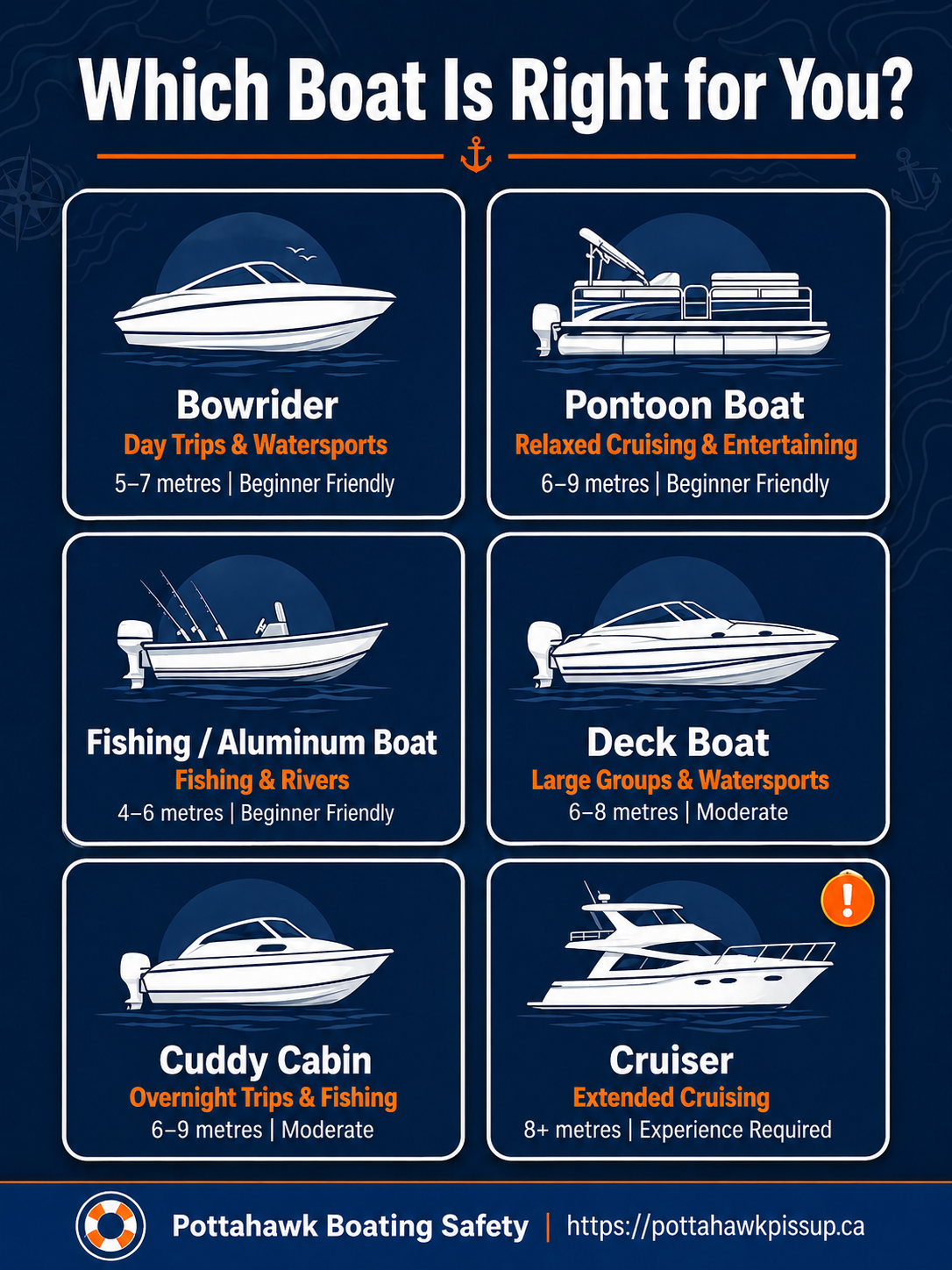
For most beginners in Ontario, a bowrider or a pontoon boat is the ideal starting point. They're stable, easy to handle, and versatile enough for everything from a quiet afternoon on the water to a day trip to Pottahawk. If you're not ready to commit to ownership, consider renting or joining a boat club for your first season to get comfortable before buying.
One practical note: when you're shopping for your first boat, make sure the motor is 10 hp or more if you want to get anywhere meaningful. And remember that the moment that motor hits 10 hp, you'll need your PCL.
Gearing Up: The Mandatory Safety Equipment You Must Carry
This is where safety becomes tangible. Transport Canada mandates that every pleasure craft carry specific safety equipment on board. The exact requirements depend on the size of your boat. For most beginners, who will likely be in a boat under 8 metres (about 26 feet), the list is very manageable.
Here’s a breakdown of the minimum required equipment for a motorized pleasure craft between 6 and 8 metres, based on the official Transport Canada Safe Boating Guide.
Personal Lifesaving Appliances
The most important item on this list is the lifejacket. You need one Canadian-approved lifejacket or PFD (Personal Flotation Device) of the appropriate size for every single person on board. This is non-negotiable. Make sure they fit properly, especially for children. A lifejacket that's too big won't keep a child's head above water.
You also need one buoyant heaving line at least 15 metres (49'3") long. This is a throwable rope you can toss to someone in the water to pull them back to the boat. If your boat's freeboard (the distance from the waterline to the top of the hull) is over 0.5 metres, you'll also need a reboarding device, like a swim ladder.
Vessel Safety Equipment
You need one manual propelling device (a paddle works) or an anchor with at least 15 metres of rope or chain. An anchor is something every beginner should have regardless of whether it's strictly required for their boat size — it's a fundamental piece of equipment for any situation where you need to hold position.
You'll also need one bailer or manual bilge pump to remove water from the boat. Even a small amount of water in the bilge can become a serious problem if left unattended.
Firefighting Equipment
A fire extinguisher is required on any boat with an inboard engine, a fixed fuel tank, or any fuel-burning cooking, heating, or refrigeration units. For most motorized pleasure craft, this means you need a Class 5BC fire extinguisher. Check the pressure gauge before every trip — an uncharged extinguisher is useless.
Navigation and Signalling Equipment
You need one watertight flashlight or six Canadian-approved pyrotechnic distress signals (flares). You don't need flares if your boat is operated in a river, canal, or lake where it can never be more than one nautical mile from shore. On Lake Erie, you absolutely need flares. As we explain in our guide to Lake Erie Boating Safety, conditions on the lake can change rapidly, and being visible to other vessels and rescue teams in an emergency can be the difference between life and death.
You need one sound-signalling device. A small, compressed-air horn or a whistle meets this requirement. Navigation lights are required if you operate your boat between sunset and sunrise or in periods of restricted visibility, like fog or heavy rain. A magnetic compass is not required if your boat is 8 metres or less and you operate it within sight of navigation marks but having one is still a good idea.
For a complete, printable version of this list, refer to our dedicated Boat Safety Equipment Checklist Canada.
The Insurance Question: Do You Really Need Boat Insurance in Canada?
Here's a fact that surprises most beginners, unlike car insurance, boat insurance is not legally required by law in Canada for recreational boaters. You can technically buy a boat and operate it without an insurance policy. But should you? Absolutely not. And here's why.
As detailed by marine insurance experts at Portside Insurance, going without boat insurance is a massive financial risk. Consider this scenario, you're at Pottahawk on a busy summer weekend, and you accidentally swing into another boat while manoeuvring. The damage to the other vessel is $15,000. Without insurance, that bill comes directly out of your pocket. Add in any personal injury claims from passengers on the other boat, and you're looking at a potential six-figure liability.
Here's why boat insurance is considered essential by the boating community:
Liability Protection: This is the big one. If you cause an accident that damages another boat or injures someone, you are financially responsible. Liability claims can run into the hundreds of thousands of dollars. Boat insurance covers these costs, including legal fees and settlement costs.
Protection for Your Investment: Boats are expensive. Insurance covers the cost of repairing or replacing your boat if it's damaged in an accident, stolen, vandalized, or damaged by weather. A single hailstorm can cause thousands of dollars in damage to an uninsured vessel.
Medical Payments Coverage: If you or your passengers are injured in an accident, medical payments coverage handles those costs. Your provincial health insurance may not cover all water-related injuries, especially if they occur in a grey area of jurisdiction.
It's Often Required Anyway: While the law doesn't require it, almost every marina, yacht club, and storage facility will. To get a slip for the season at any marina on Lake Erie or any of the Great Lakes for that matter, you will need to provide proof of liability insurance. Similarly, if you finance your boat, the lender will mandate comprehensive coverage as a condition of the loan.
Think of boat insurance as a non-negotiable cost of ownership. It provides peace of mind and protects you from a catastrophic financial loss for a relatively small annual premium. Talk to a marine insurance broker before you buy your first boat, not after.
Understanding the Rules of the Water
Just like driving a car, boating comes with a set of rules that govern how vessels interact with each other. These are not just suggestions. They're the law, and understanding them is essential for your safety and the safety of everyone around you.
Right of Way: Who Goes First?
The basic hierarchy of right-of-way on Canadian waterways is straightforward once you understand it. Vessels that are less manoeuvrable have the right of way over those that are more manoeuvrable. Here's how it works in practice:
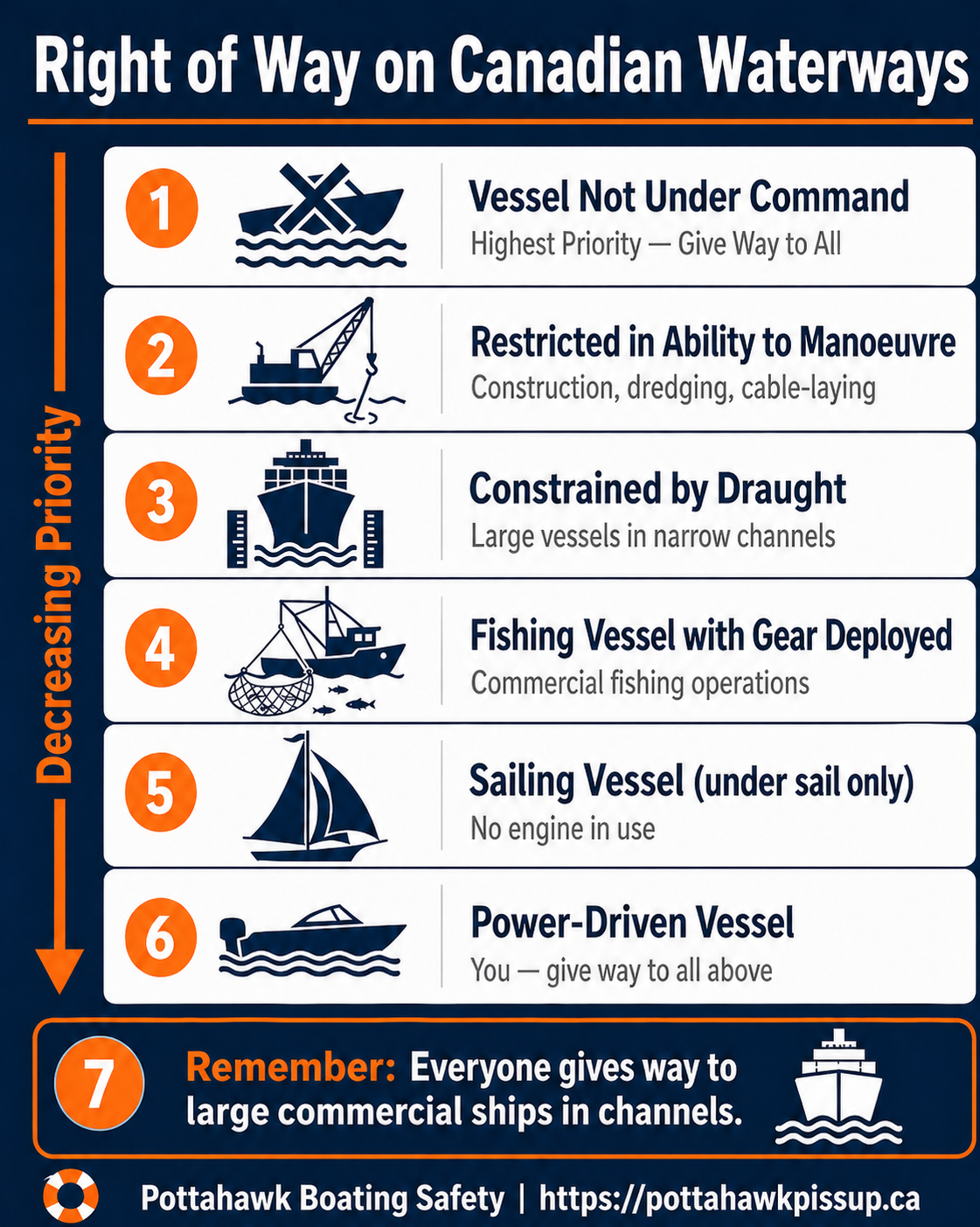
In plain language, if you're in a powerboat, you give way to sailboats. Everyone gives way to large commercial ships. And if you're approaching another powerboat head-on, both vessels should turn to starboard (right) to pass port-to-port (left side to left side).
The Rules for Overtaking
When you're overtaking another vessel, you can pass on either side, but you must do so in a way that keeps you well clear of the vessel being overtaken. The vessel being overtaken has the right of way and must maintain its course and speed until you are safely past.
Speed and Wake
There is no universal speed limit on most Canadian waterways, but there are rules about operating in a manner that is safe for the conditions. Many harbours, marinas, and channels have posted speed limits, typically 10 km/h. Exceeding these limits or creating a wake that damages other vessels or shoreline property is an offence.
Mind your wake. This is one of the most important pieces of etiquette on the water. Your wake can swamp a small boat, injure someone on a dock, or cause shore erosion. Slow down when you're near shore, in narrow channels, and when passing anchored or docked vessels.
Buoys and Markers
Understanding the buoy system is fundamental to safe navigation. The basic rule in Canadian waters is "red right returning" when you're returning to port (heading upstream or toward shore), keep the red buoys on your right (starboard) side. Green buoys go on your left (port) side. This system keeps you in the safe, navigable channel.
Our upcoming guide on the Safest Routes Across Lake Erie (coming April 1, 2026) will cover navigation markers and channel buoys in detail for those planning to make the crossing.
A Word on Youth Operators: Rules for Young Boaters
Canada has specific rules to ensure young boaters can enjoy the water safely. In addition to needing their PCOC, operators under the age of 16 face horsepower restrictions that are strictly enforced:
Under 12 years old: Can operate a boat with up to 10 hp (7.5 kW) without direct supervision from an adult.
Ages 12 to 15: Can operate a boat with up to 40 hp (30 kW) without direct supervision.
Under 16 years old: Cannot operate a personal watercraft (like a Jet Ski or Sea-Doo) under any circumstances, regardless of supervision.
"Direct supervision" means someone 16 or older, who also has their PCOC, is physically present in the boat and actively supervising the young operator. It's not enough to be watching from the dock.
These rules exist for good reason. Young operators are still developing the spatial awareness, reaction time, and judgment required to handle a fast-moving vessel safely. Respecting these limits is not about limiting fun, it's about making sure there's a next time.
Weather and Water Awareness: The Skill That Keeps You Safe
No beginner's guide to boating would be complete without a serious conversation about weather. This is, without question, the area where new boaters are most vulnerable. The water looks calm. The sky looks clear. And then, seemingly out of nowhere, everything changes.
This is especially true on Lake Erie. As we explain in detail in our Lake Erie Weather Pattern Survival Guide, the lake is uniquely prone to rapid weather changes. Its shallow depth means waves build faster and steeper than on deeper lakes. A 20-knot wind can turn a pleasant afternoon into a dangerous situation in under an hour.
Here are the habits that will keep you safe:
Check the forecast before you leave. Not just the general weather app on your phone. Use a marine-specific forecast from Environment and Climate Change Canada. Look for wind speed and direction, wave height, and any small craft warnings or advisories. If there's a small craft warning in effect, stay home.
Watch the sky. Dark clouds building to the west are your first warning. If you see a line of dark cloud approaching, get off the water. Thunderstorms can move faster than you think, and lightning on the water is extremely dangerous.
Know your limits. As a beginner, your comfort zone should be calm to light conditions. Waves of 0.5 to 1 metre are manageable in a well-equipped boat. Anything over 1 metre should give you pause. Anything over 1.5 metres is not a beginner's environment.
Have a plan for getting caught out. Know where the nearest harbour of refuge is before you leave. On Lake Erie's north shore, that might be Port Dover, Port Stanley, or Erieau, depending on where you are. If conditions deteriorate, head for shelter immediately. Don't wait to see if it gets better.
Cold water is another hazard that beginners often underestimate. Even in summer, Lake Erie's water temperature can be cold enough to cause cold water shock and incapacitation within minutes of immersion. Our detailed guide on Cold Water Boating Risks on the Great Lakes covers this in depth and is essential reading before your first trip.
Your First Trip: A Simple Pre-Departure Checklist
You've done the reading. You've got your PCOC and your PCL. Your boat is equipped. Now it's time to actually go. Before you cast off, run through this simple checklist every single time you head out. It takes five minutes and it could save your life.
Documents and Identification
PCOC card (physical card, not a copy)
Pleasure Craft Licence copy
Boat insurance documents
Safety Equipment
Lifejackets for every person on board and check that they fit
Fire extinguisher and check the pressure gauge
Flares and check the expiry date (flares expire after 4 years)
Heaving line
Whistle or horn
Flashlight with fresh batteries
Vessel Check
Fuel level and remember the one-third rule; one-third to go, one-third to return, one-third in reserve
Engine oil level
Bilge check for water and ensure the bilge pump works
Navigation lights test them before sunset trips
Anchor and chain (rope) and ensure that it is stowed and ready
Trip Planning
Check the marine weather forecast
File a float plan and tell someone where you're going and when you expect to be back
Charge your phone or VHF radio
Know the location of the nearest harbour of refuge
Boating is one of the most rewarding activities you can do in Canada. It connects you with nature, with family, and with a vibrant community of fellow boaters. By taking these foundational steps, getting your licence, equipping your boat properly, understanding the rules, and respecting the water, you're not just preparing for a hobby. You're investing in a lifetime of safe and incredible adventures on the water. And if your adventures ever bring you to Lake Erie's north shore, our Complete Guide to the Pottahawk Pissup will make sure you're ready for one of Canada's most legendary boating events.
Frequently Asked Questions
Q: Do I need a boating licence to operate a canoe or kayak?
No. The requirement for a Pleasure Craft Operator Card (PCOC) only applies to motorized vessels. You do not need a PCOC for human-powered craft like canoes, kayaks, or paddleboards. However, you are still required to carry certain safety equipment, including a lifejacket and a sound-signalling device.
Q: How long is my Pleasure Craft Operator Card (PCOC) good for?
Your PCOC is valid for life. It never expires and does not need to be renewed. If you lose it, contact the accredited course provider who originally issued your card to get a replacement.
Q: Is my Canadian PCOC valid in the United States?
Yes. The Canadian PCOC is recognized by the U.S. Coast Guard and the National Association of State Boating Law Administrators (NASBLA) as meeting their requirements. Similarly, U.S. boater education cards are recognized in Canada.
Q: What happens if I get caught operating a boat without a PCOC?
If you are caught operating a motorized pleasure craft without proof of competency, you face a fine of $250, plus administrative fees. The fine applies to the operator, not the boat owner.
Q: Is boat insurance legally required in Canada?
No. Unlike automobile insurance, boat insurance is not mandated by federal or provincial law in Canada. However, it is strongly recommended, and most marinas, yacht clubs, and storage facilities require proof of liability insurance as a condition of docking or storing your vessel.
Q: How old do you have to be to drive a boat in Canada?
There is no minimum age to operate a boat in Canada, provided the operator has their PCOC and complies with the horsepower restrictions. Children under 12 can operate a boat with up to 10 hp unsupervised. Children aged 12 to 15 can operate a boat with up to 40 hp unsupervised. No one under 16 can operate a personal watercraft (PWC) under any circumstances.
Q: What is the difference between a Pleasure Craft Licence and Vessel Registration?
A Pleasure Craft Licence (PCL) is a free, 10-year identification number for your boat. It does not prove ownership. Vessel Registration is a paid process ($250) that provides legal title, proof of ownership, and allows you to give your boat an official name and most recreational boaters only need a PCL.
Sources & Further Reading
Tags
Share
Read Next
 Guides
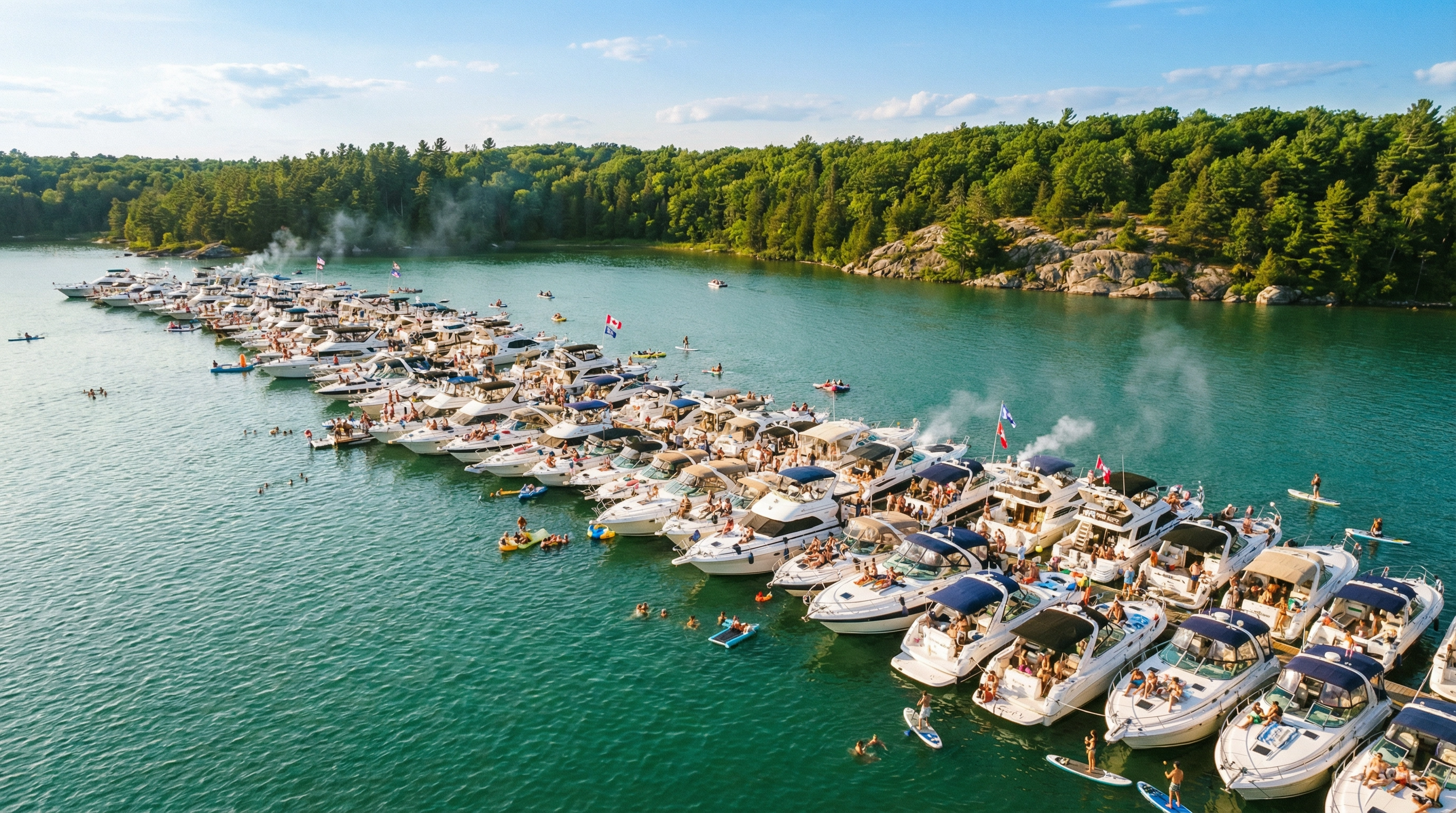
The Ultimate Guide to Raft-Up Safety: From Casual Cove to Pottahawk Chaos
There's a unique magic that happens when boats tie together on the water. It's the floating equivalent of a neighbourhood block party, a communal experience that turns individual vessels into a single, lively platform for swimming, grilling, and socializin

Dwayne Rodrigues
Boat Owner & Enthusiast
 Guides
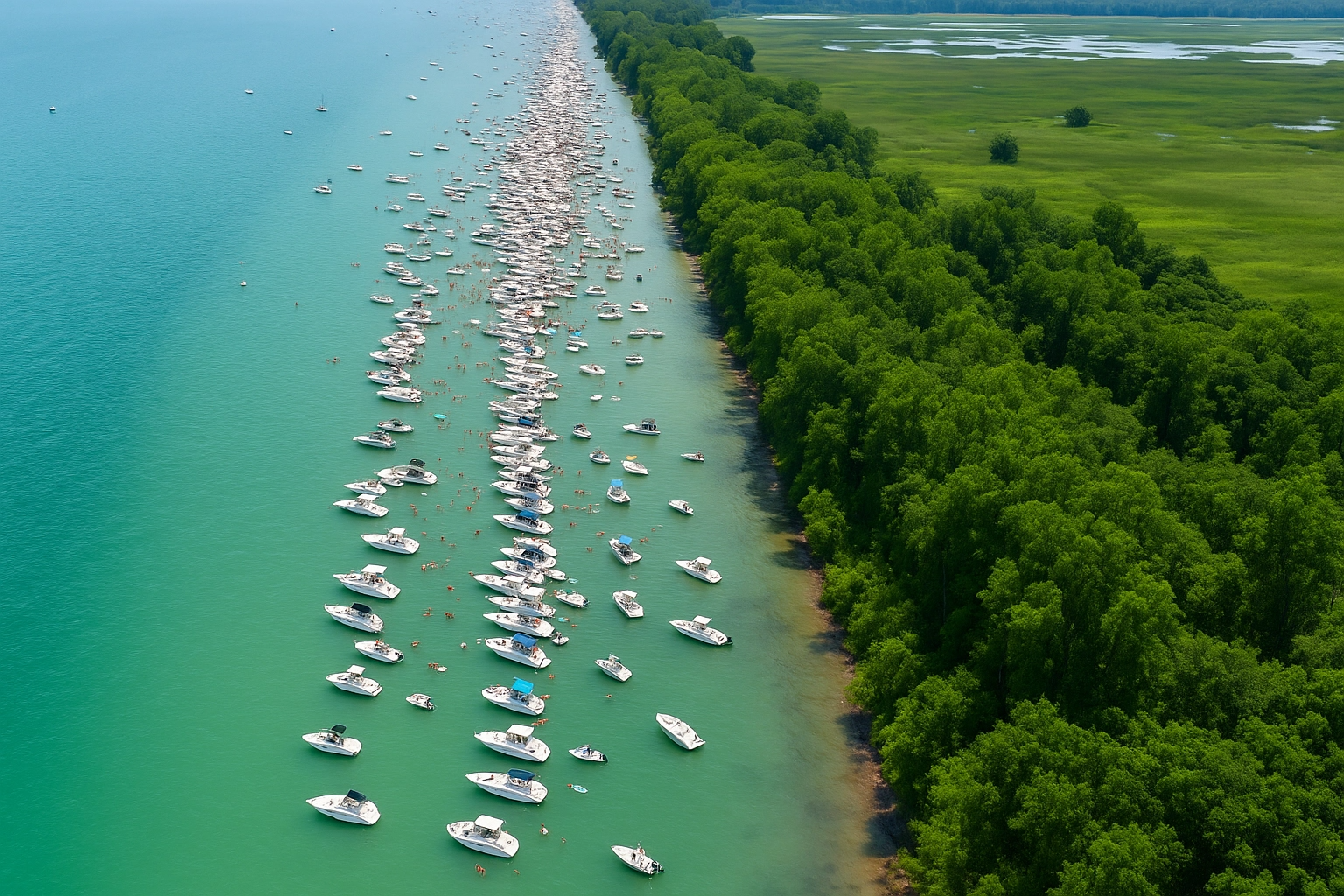
The Complete Guide to the Pottahawk Pissup
The Pottahawk Pissup is an unofficial, unsanctioned boat party held on the second Sunday of July at Pottahawk Point in Long Point Bay, Lake Erie. It is not an organized event. There are no official organizers, no tickets, and no formal schedule.
Dwayne Rodrigues
Boat Owner & Enthusiast
 Guides
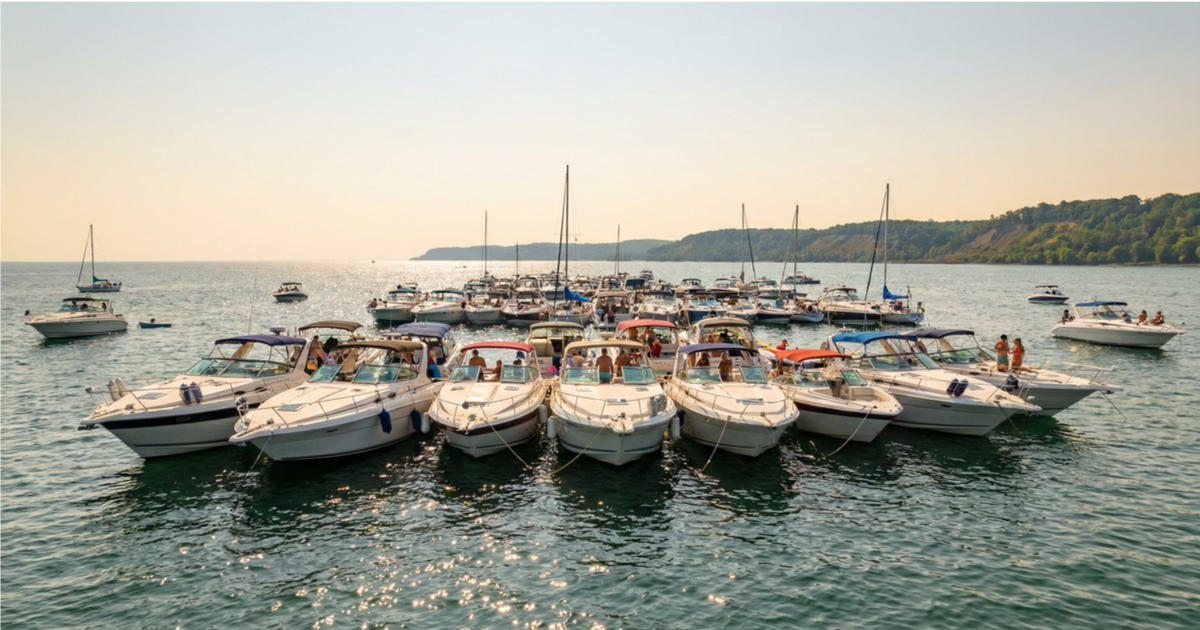
Raft-Up Safety Mistakes That Cause Damage
There’s nothing quite like it. The sun is high, the water is warm, and you’re surrounded by friends, old and new, all tied together in a floating community. The raft-up is a cornerstone of the boating lifestyle, especially for events like Pottahawk.
Dwayne Rodrigues
Boat Owner & Enthusiast