Crossing Lake Erie Safely: The Ultimate Guide for Canadian Boaters
Crossing Lake Erie by boat is a rite of passage for many Canadian boaters. There is something undeniably thrilling about leaving the north shore behind, watching the land slowly disappear below the horizon, and navigating across open water to a completely

Dwayne Rodrigues
Boat Owner & Enthusiast
Quick Takeaways:
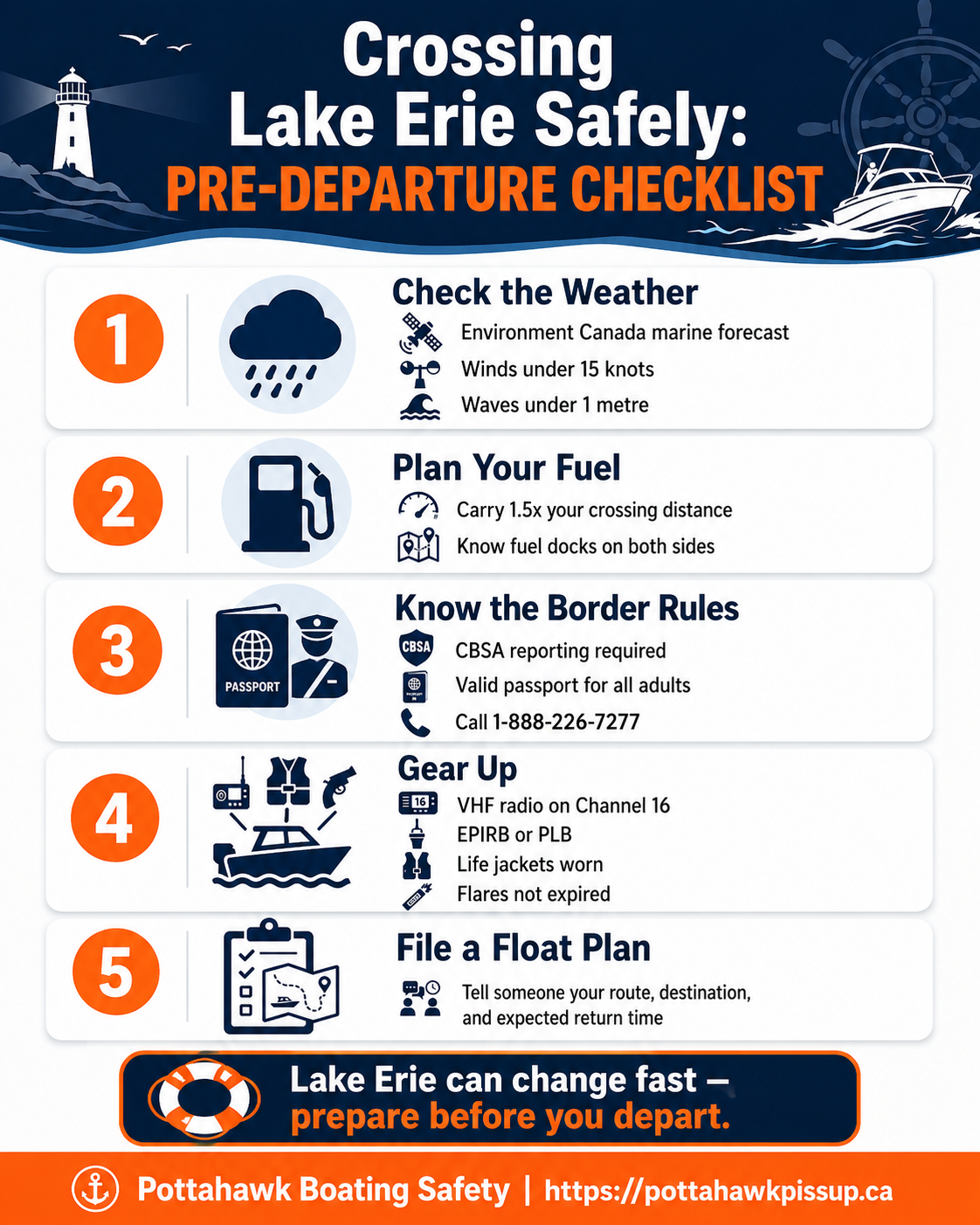
Check the weather: Lake Erie is the shallowest Great Lake and produces steep, dangerous waves very quickly. Always check the Environment Canada marine forecast before departing.
Know the reporting rules: All boaters entering Canadian waters must report to the CBSA by calling 1-888-226-7277 or using a designated marine reporting site. Failure to report carries a minimum $1,000 fine.
Plan your fuel: The crossing from Port Dover to Erie, PA is approximately 28 nautical miles. Always carry enough fuel for 1.5 times your planned crossing distance.
Carry the right gear: A VHF radio, EPIRB or PLB, and all Transport Canada required safety equipment are non-negotiable for open water crossings.
Crossing Lake Erie by boat is a rite of passage for many Canadian boaters. There is something undeniably thrilling about leaving the north shore behind, watching the land slowly disappear below the horizon, and navigating across open water to a completely different country. But let me be perfectly clear right from the start: Lake Erie is not a body of water you can take lightly.
It might be the smallest of the Great Lakes by volume, but it is also the shallowest. That unique geography means it behaves differently than Lake Ontario or Lake Huron. When the wind kicks up, Lake Erie does not produce long, rolling ocean swells. Instead, it generates steep, closely packed waves that can turn a comfortable cruise into a dangerous situation in a matter of minutes.
If you are planning to cross Lake Erie this season, whether you are heading from Port Dover to Erie, Pennsylvania, or making the shorter hop from Port Colborne to Buffalo, you need to be prepared. This guide covers everything you need to know to cross Lake Erie safely, from choosing the right weather window and understanding CBSA reporting requirements, to planning your fuel stops and carrying the right safety gear.
Why Lake Erie Demands Respect
Before we get into the logistics of the crossing, we need to talk about the lake itself. You know what? A lot of boaters look at a map, see that Lake Erie is only about 50 miles wide at its widest point, and assume it is an easy afternoon run. That assumption has gotten a lot of people into serious trouble.
Lake Erie is approximately 241 miles long, but its average depth is only 62 feet. The western basin, stretching from Point Pelee over to Toledo, is even shallower, averaging just 24 feet deep. This shallow depth is the primary reason Why Lake Erie Turns Dangerous.
When strong winds blow across the lake, especially from the southwest or northeast—they push the water into steep, choppy waves that have very little distance between their peaks. These waves can build incredibly fast. You can leave the dock in flat calm conditions and find yourself fighting three-to-five-foot square waves an hour later.
Real-World Reminders
We do not have to look far back in history to see the consequences of underestimating this lake. In July 2025, a boat capsized off Avon Lake, Ohio, resulting in a tragic fatality. Just a month later, in August 2025, the Coast Guard had to rescue four people after their boat flipped in open water.
These incidents are sobering reminders that open water crossings require serious preparation. You are leaving the sheltered waters of Long Point Bay and entering an environment where you are entirely self-reliant.
Choosing Your Crossing Route
The route you choose will depend entirely on where you keep your boat and where you want to end up. Here are the three most common crossing routes for Canadian boaters.
1. The Central Crossing: Port Dover to Erie, PA
This is arguably the most popular recreational crossing route. The distance from Port Dover, Ontario, straight across to Presque Isle Bay in Erie, Pennsylvania, is approximately 28 nautical miles (52 kilometres).
For a powerboat cruising at 20 knots, this is a very manageable trip of about an hour and a half, assuming good conditions. Erie is a fantastic destination, offering excellent marinas, restaurants, and the beautiful Presque Isle State Park.
2. The Eastern Hop: Port Colborne to Buffalo, NY
If you are located at the eastern end of the lake, the crossing from Port Colborne or Fort Erie over to Buffalo is much shorter—roughly 16 nautical miles (30 kilometres). This route is popular for boaters looking to access the Erie Canal system or simply spend a weekend in downtown Buffalo.
3. The Western Basin: Kingsville to Sandusky, OH
Boaters in the western basin often cross from Kingsville or Leamington over to Sandusky or the Lake Erie Islands (like Put-in-Bay). This crossing is about 24 nautical miles (45 kilometres).
While the distance is manageable, remember that the western basin is the shallowest part of the lake. It is highly susceptible to sudden wave action, and you must pay close attention to your charts to Avoid Running Aground on the numerous shoals and reefs in the area.
The Weather Window: When to Go and When to Stay
Honestly, the single most important decision you will make regarding your crossing is choosing the right weather window. If the forecast is marginal, stay at the dock. It is that simple.
Reading the Marine Forecast
You should be checking the Environment Canada marine forecast (weather.gc.ca/marine) at least 24 hours before your planned departure, and then checking it again right before you cast off.
Pay close attention to the wind speed and direction. On Lake Erie, prevailing winds in the summer are typically from the southwest. If the forecast calls for winds exceeding 15 knots, or wave heights over 1 metre (3 feet), that is generally a sign to delay your crossing, especially if you are in a boat under 25 feet.
The Morning Advantage
Experienced Lake Erie boaters know that the best time to cross is usually early in the morning. Thermal winds caused by the temperature difference between the land and the water tend to build throughout the afternoon. If you can leave the dock by 6:00 AM or 7:00 AM, you have a much better chance of enjoying a smooth, glassy crossing before the afternoon chop kicks up.
Customs and Border Protection: The Legal Requirements
Crossing an international border by boat involves strict legal requirements. You cannot simply pull up to a dock in another country and head to the nearest patio for lunch.
Entering the United States
If you are a Canadian boater crossing into US waters and touching land, anchoring, or mooring, you must report your arrival to US Customs and Border Protection (CBP).
The easiest way for frequent crossers to handle this is by obtaining an I-68 permit, which allows you to report your arrival by phone. Alternatively, if everyone on board has a NEXUS card, you can use the NEXUS marine reporting procedures.
Regardless of the method, every person on board who is 16 years of age or older must carry a valid passport or a NEXUS card.
Returning to Canada (CBSA Reporting)
When you return to Canadian waters, the rules are equally strict. According to the Canada Border Services Agency (CBSA), if you leave Canadian waters, land outside Canada, and then return, you must report to the CBSA immediately upon your return.
You have two main options for reporting:
Telephone Reporting Centre (TRC): You can call the TRC at 1-888-226-7277 from your cell phone once you are back in Canadian waters, provided you meet the conditions for an exception.
Designated Marine Reporting Site: You can proceed directly to an open designated marine reporting site (such as the public docks in Port Dover or Port Colborne) and use the dedicated telephone there to report.
If everyone on board is a NEXUS member, you must call the NEXUS marine reporting line (1-866-996-3987) at least 30 minutes, and up to four hours, before arriving in Canada.
Do not ignore these rules. The CBSA actively monitors Canadian waterways. Failure to report carries a minimum fine of $1,000 CAD, and could result in the seizure of your vessel.
Fuel Planning and Management
Running out of fuel in the middle of Lake Erie is a nightmare scenario. You are adrift, at the mercy of the wind and waves, and in the path of commercial shipping traffic.
When planning your crossing, you must calculate your fuel consumption accurately. Do not rely solely on your fuel gauge, as they can be notoriously inaccurate on boats as the fuel sloshes around in the tank.
The Rule of Thirds (Plus a Margin)
The standard boating rule of thirds dictates that you use one-third of your fuel to get there, one-third to get back, and keep one-third in reserve.
For a Lake Erie crossing, I prefer an even more conservative approach: always carry enough fuel for 1.5 times your planned crossing distance.
Why? Because if the weather turns bad, you will not be running at your optimal cruising speed. You will be fighting waves, which drastically reduces your fuel efficiency. You might also need to alter your course to take waves at a better angle, adding miles to your trip.
Before you leave, map out the fuel docks on both sides of the lake. Know exactly where you can fill up in Port Dover, Port Stanley, Erie, or Cleveland.
Essential Safety Gear for the Crossing
You are already required to carry specific safety gear by Transport Canada, which we cover in detail in our Essential Boating Safety Equipment Checklist. However, an open water crossing requires you to go above and beyond the legal minimums.
Communication is Critical
Your cell phone is not a reliable safety device in the middle of Lake Erie. You will likely lose cellular service about 10 miles offshore.
A fixed-mount VHF marine radio with Digital Selective Calling (DSC) is absolutely essential. Ensure it is connected to your GPS so that if you press the red distress button, it automatically broadcasts your exact coordinates to the Coast Guard and all surrounding vessels. You should be monitoring Channel 16 (the international distress and calling channel) for the entire duration of your crossing.
Emergency Beacons
For open water crossings, I strongly recommend carrying an Emergency Position Indicating Radio Beacon (EPIRB) or a Personal Locator Beacon (PLB). If the worst happens and your boat capsizes or sinks, these devices transmit a distress signal directly to search and rescue satellites, bypassing the need for VHF range or cellular towers.
Visual Distress Signals
Transport Canada requires flares, but make sure they are not expired. Consider upgrading to electronic visual distress signals (e-flares), which never expire and can emit an SOS signal for hours.
The Float Plan
Never cross the lake without filing a float plan. This does not need to be a formal document; it can be a detailed text message to a reliable friend or family member on shore. Tell them exactly where you are leaving from, your intended destination, your planned route, and your expected arrival time. Most importantly, tell them what time they should call the Coast Guard if they have not heard from you.
Boat Size and Capability
What size boat do you need to cross Lake Erie? There is no legal minimum size set by Transport Canada, but common sense and experience dictate that you need a vessel capable of handling open water conditions.
Generally speaking, a boat of 20 feet or larger is recommended for crossing Lake Erie. However, the design of the boat matters just as much as the length. A 22-foot deep-V center console designed for offshore fishing is much more capable of handling Lake Erie chop than a 24-foot flat-bottomed deck boat designed for calm inland lakes.
If you are in a smaller boat (under 20 feet), you are taking a significant risk. You must be absolutely certain of a perfect, glassy weather window, and you must be prepared to turn back at the first sign of building waves.
Navigating the Crossing
Once you are out there, navigation is usually straightforward, but you cannot rely on a single point of failure.
Your primary navigation tool will likely be your GPS chartplotter. Ensure your charts are updated and that you have plotted your route before leaving the dock.
However, electronics can fail. You should always carry paper nautical charts of Lake Erie as a backup, and you need to know how to use them. If you are rusty on your chart reading skills, review our guide on How to Read Nautical Charts for Beginners.
Keep a sharp lookout for commercial shipping traffic. Lake Erie is a busy commercial waterway, and freighters move much faster than they appear. Remember the rules of the road: recreational vessels must give way to large commercial ships constrained by their draft in shipping channels.
Emergency Procedures: What to Do If Things Go Wrong
Even with the best preparation, things can go wrong on the water. Knowing how to react in an emergency is just as important as trying to prevent one.
Engine Failure
If your engine dies in the middle of the lake, your first priority is to stabilize the boat. If you are in deep water, you cannot anchor. You need to deploy a sea anchor (or drogue) from the bow to keep the boat pointed into the waves. This prevents the boat from turning broadside to the waves, which is the most dangerous position and can lead to capsizing.
Once the boat is stable, use your VHF radio to call for assistance. If you are not in immediate danger, you can call a commercial towing service (like C-Tow or TowBoatUS) on Channel 16. If you are in immediate danger, issue a Mayday call.
Taking on Water
If you hit a submerged object or a fitting fails and you start taking on water, immediately turn on your bilge pumps. If the pumps cannot keep up, find the source of the leak and try to plug it with whatever you have available—towels, clothing, or wooden plugs.
Issue a Mayday call on Channel 16 immediately. Do not wait until the boat is sinking to call for help. Ensure everyone on board is wearing a life jacket.
Man Overboard
If someone falls overboard, shout "Man Overboard!" and immediately throw a life ring or buoyant cushion toward them to mark their position. Assign one person on the boat to do nothing but point at the person in the water. Do not take your eyes off them.
Turn the boat around carefully and approach the person from downwind, so the wind blows the boat toward them, not over them. Turn off the engine before bringing them back on board.
Conclusion: Respect the Lake
Crossing Lake Erie is an incredibly rewarding experience that opens up a whole new world of boating destinations. But it requires preparation, respect for the weather, and a commitment to safety.
Check the forecast, file your float plan, ensure your gear is in top condition, and understand the border reporting rules. If you do those things, you will be well on your way to a safe and memorable crossing. See you out on the water.
Frequently Asked Questions (FAQ)
What is the best time of day to cross Lake Erie? The best time to cross Lake Erie is early in the morning, typically between 6:00 AM and 10:00 AM. Thermal winds build throughout the afternoon, which can create choppy, uncomfortable, and potentially dangerous wave conditions later in the day.
Do I need a passport to cross Lake Erie into the US? Yes. Every person on board who is 16 years of age or older must carry a valid passport or a NEXUS card when crossing into US waters and touching land, anchoring, or mooring.
What happens if I don't report to CBSA when returning to Canada? Failure to report to the Canada Border Services Agency (CBSA) upon returning to Canadian waters carries a minimum fine of $1,000 CAD. It can also result in the seizure of your vessel and affect your future ability to cross the border.
How much fuel should I carry for a Lake Erie crossing? You should always carry enough fuel for 1.5 times your planned crossing distance. This conservative approach ensures you have enough fuel if you encounter rough weather, which significantly reduces fuel efficiency, or if you need to alter your course.
Is my cell phone enough for emergencies on Lake Erie? No. Cellular service is unreliable and often non-existent once you are more than 10 miles offshore. A fixed-mount VHF marine radio with Digital Selective Calling (DSC) is essential for open water crossings.
What size boat is safe for crossing Lake Erie? While there is no legal minimum size, a boat of 20 feet or larger is generally recommended for crossing Lake Erie. The design of the boat (e.g., a deep-V hull) is also crucial for handling open water conditions. Smaller boats are at a much higher risk and should only cross in perfect, glassy weather windows.
What should I do if my engine fails in the middle of the lake? If your engine fails, deploy a sea anchor (drogue) from the bow to keep the boat pointed into the waves and prevent capsizing. Once stable, use your VHF radio to call for assistance (Channel 16 for emergencies, or contact a commercial towing service if not in immediate danger).
Sources & Further Reading
Tags
Share
Read Next
 Cruising & Locks
Toronto to Pottahawk 2026: Surviving the Crossing & Welland Canal
So, you're thinking about making the trek from Toronto to Pottahawk. Good on you! It's a rite of passage for any serious Lake Ontario boater, a proper adventure that separates the weekend warriors from the seasoned captains. But let's be honest, it's not

Dwayne Rodrigues
Boat Owner & Enthusiast