The Ultimate Guide to Raft-Up Safety: From Casual Cove to Pottahawk Chaos
There's a unique magic that happens when boats tie together on the water. It's the floating equivalent of a neighbourhood block party, a communal experience that turns individual vessels into a single, lively platform for swimming, grilling, and socializin

Dwayne Rodrigues
Boat Owner & Enthusiast
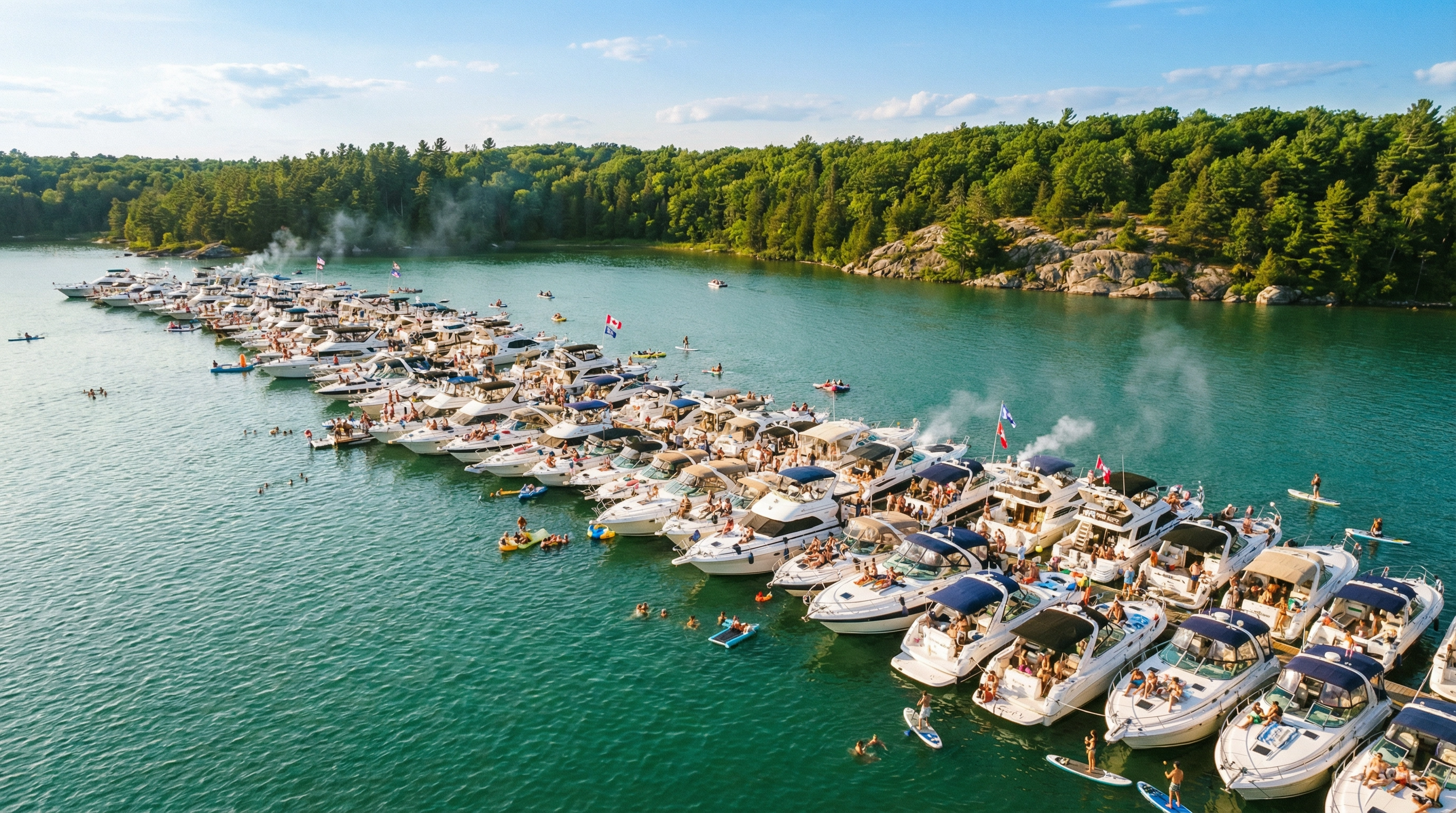
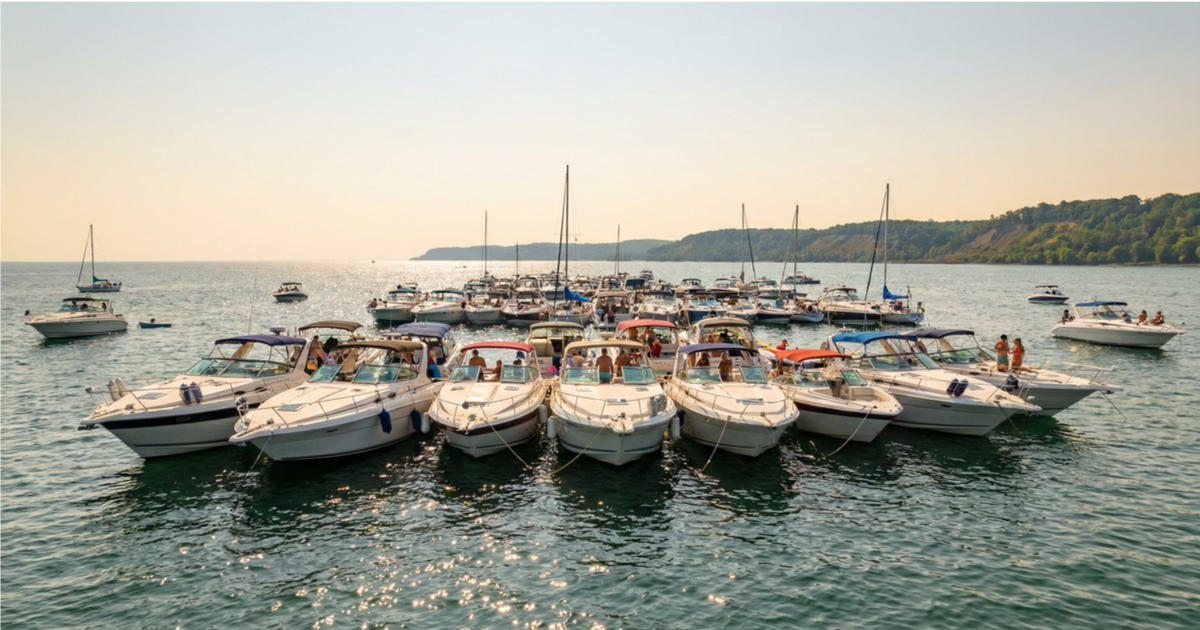
There's a unique magic that happens when boats tie together on the water. It's the floating equivalent of a neighbourhood block party, a communal experience that turns individual vessels into a single, lively platform for swimming, grilling, and socializing. At its best, a raft-up is the heart of the boating lifestyle, a tradition that builds community and creates lasting memories on the Great Lakes.
But as anyone who has witnessed a sudden squall sweep through a crowded anchorage knows, that magic can evaporate in an instant. A successful raft-up, especially a large one, doesn't just happen by chance. It's a carefully executed maneuver that requires communication, preparation, and a solid understanding of seamanship. When done correctly, it's a seamless and safe experience. When done poorly, it can lead to damaged boats, frayed nerves, and genuinely dangerous situations.
This guide is your definitive playbook for mastering the art of the raft-up. We're going to cover everything from the casual three-boat gathering in a quiet cove to navigating the controlled chaos of a massive, 200-boat event like the Pottahawk Pissup. Whether you're a first-timer or a seasoned captain, this guide will equip you with the knowledge to raft-up with confidence, safety, and skill.
Quick Takeaways
The Mindset Shift is Critical: A 200-boat raft-up is not a 10-boat raft-up scaled up. It's a floating city that demands a strategic, safety-first mindset, not a casual social one.
The Heaviest Boat Anchors First: This is the cardinal rule. The largest, most stable boat sets the primary anchor and becomes the foundation for the entire raft-up.
Two Anchors are Non-Negotiable for Stability: In any raft-up of more than two boats, a single bow anchor is not enough. A second stern anchor is the professional standard to prevent swinging and ensure stability.
Fenders and Lines are Your Best Friends: You can never have too many. Use large fenders and a crisscross "X" pattern of spring lines to lock boats together tightly, preventing grinding and damage.
The Designated Operator is Your MVP: In a crowded, high-stakes environment, a sober, alert captain isn't just a good idea, it's the most critical safety system on your boat.
The Mindset Shift: From Block Party to Floating City
The first thing you have to understand is that the dynamics of a massive raft-up are completely different from a small, casual one. In a small group of friends, you know everyone's experience level, you can trust their equipment, and you can shout instructions across the water. It's a relaxed, social environment where a mistake is usually a minor inconvenience.
A 200-boat raft-up is a temporary city populated by strangers. You have no idea about their level of experience, the condition of their ground tackle, or their state of sobriety. You must operate with a defensive mindset, assuming nothing and preparing for everything. It's less like a backyard barbecue and more like navigating a crowded urban environment. You need to be constantly aware of your surroundings, anticipate the actions of others, and have contingency plans for when things go wrong.
Here's the physics lesson that drives this mindset home. The anchor from the first boat in a line is carrying the load for every boat tied to it. If that anchor drags, it's not just one boat that moves, the entire line will start to drift, swinging into other lines of boats. This is how a single point of failure can cause a massive, dangerous domino effect. This is why the mindset shift from casual social participant to strategic safety manager is the single most important factor in successfully navigating a large-scale event.
Before You Go: The Pre-Launch Briefing
Success at a large raft-up is determined long before you cast off your dock lines. It's won in the driveway, at the launch ramp, and in the conversations you have with your crew. If you're just winging it, you've already lost.
Your Vessel's Readiness: Beyond the Basics
Your boat needs to be more than just running; it needs to be 100% ready for a demanding day.
Mechanical Check-Up: This is not the day to find out your bilge pump is faulty or your battery is on its last legs. Do a thorough pre-launch check of all systems: engine, steering, throttle, and all electrical components. If something has been making a funny noise, get it looked at before the event, not after.
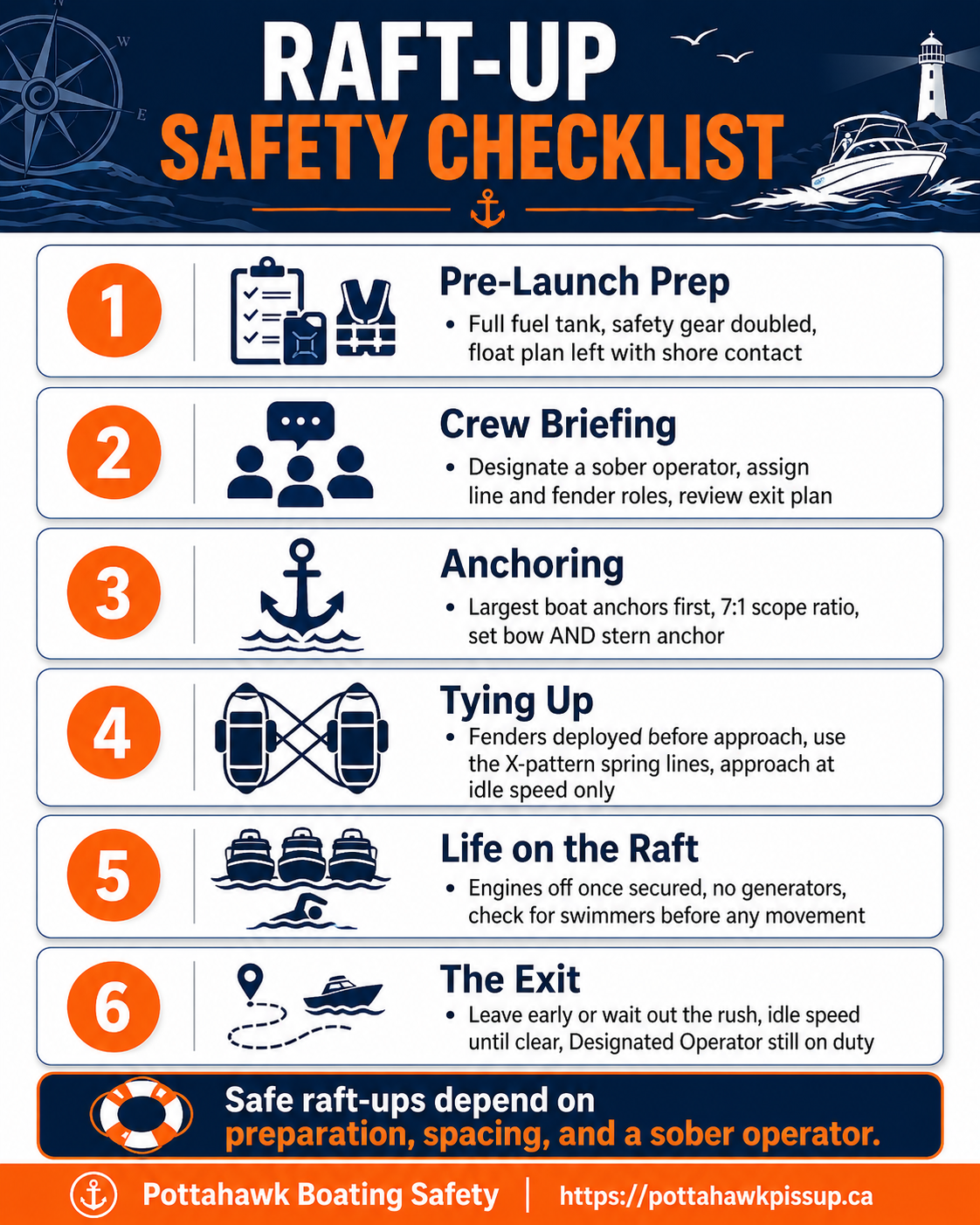
Fuel for the Whole Day (and Then Some): The lines at the fuel dock will be a nightmare. Start with a completely full tank. The professional standard is the rule of thirds: one-third of your fuel to get there and maneuver, one-third to get home, and a full one-third in reserve for emergencies. Running out of gas in the middle of a massive raft-up is a rookie move that puts you and others at risk.
Safety Gear Overload: Our Lake Erie Boating Safety Guide covers the minimum required equipment under Transport Canada regulations. For a large raft-up, you need to go beyond that minimum. Double your number of fenders, you'll want at least four to six, and large ones at that. Pack extra dock lines of varying lengths. A second anchor (a stern anchor) is not optional in this environment; it's a necessity for stability. Make sure your first-aid kit is fully stocked and easily accessible.
Your Crew's Readiness: The Human Element
Your crew is your team, and they need a game plan before you leave the dock.
The Designated Operator (The Sober Skipper): This cannot be stressed enough. The single greatest risk factor at any large boat gathering is impaired operation. The OPP Marine Unit and other marine patrols will be out in force, and their tolerance for intoxicated captains is zero. As we cover in detail in our post on the dangers of impaired boating in Canada, the consequences of boating under the influence are severe and life-altering. Your Designated Operator is the person who agrees to consume no alcohol or impairing substances, period. They are the captain, and their word is law for the day. If you don't have a committed, reliable person for this role, you should not go.
The Pre-Trip Huddle: Before you leave the dock, gather your entire crew for a five-minute briefing. Show everyone where the safety gear is located. Explain the plan for the day. Assign roles for docking and anchoring — who handles the bow lines, who handles the stern, who deploys the fenders. Everyone should know who the captain is and that their instructions must be followed immediately and without argument. This isn't about being bossy; it's about ensuring clear, calm execution in a potentially chaotic environment.
The Float Plan: Your Lifeline
For a regular day on the water, a float plan is a smart idea. For a massive raft-up, it's an absolute necessity. Before you go, leave a detailed float plan with a reliable person on shore. This should include a description of your boat (name, registration number, colour, and length), the names of everyone on board, your planned destination, and your estimated time of return. Transport Canada has excellent resources on what to include in a proper float plan. If you're overdue, this is the information that search and rescue teams will use to start looking for you.
The Foundation: Anchoring for a Raft-Up
Everything starts with the anchor. The entire stability of the raft-up depends on the first boat getting this right. According to the experts at Discover Boating, the largest and heaviest boat in the group should always be the one to set the main anchor. This boat becomes the cornerstone for the entire structure.
The captain of the anchor boat should choose a location with plenty of swinging room, away from heavy traffic, and set their anchor securely. This means using a proper scope, a ratio of at least 7:1, seven feet of anchor line for every one foot of water depth. Once the anchor is firmly set, the raft-up can begin to form, with other boats tying off on alternating sides to keep the weight balanced.
The Two-Anchor Technique: The Pro Move
In a crowded environment with shifting winds, a single bow anchor is not enough. Your boat will swing like a pendulum on that single point, and in a tight raft-up, that pendulum swing will put your hull into your neighbour's hull. The professional move, and the one that will earn you nods of respect from experienced boaters, is to set a stern anchor as well.
After your bow anchor is set, motor back slowly and drop a second, smaller anchor off the stern. This will keep your boat locked in place, preventing it from swinging into your neighbors. It provides a level of stability and security that is essential in a tight, crowded raft-up. It's more work, but it's the right way to do it. This two-anchor technique is also the standard recommendation for anyone attending the Pottahawk Pissup, as we detail in our Pottahawk for Beginners guide.
The Connection: Tying Up Like a Pro
Once the anchor boat is set, it's time to start connecting. This is a slow, deliberate process that requires clear communication and proper technique.
Step 1: Prepare Your Lines and Fenders. Before you even approach the raft-up, have your lines and fenders ready. You'll need at least two fenders per side and four dock lines. As Boating Magazine advises, hang your fenders before you get close. It's much easier to adjust them as you come alongside than to try and deploy them in the middle of a maneuver.
Step 2: Communicate Your Intentions. Make eye contact with the captain of the boat you're tying up to. Use hand signals or a quick call to confirm you're coming alongside and on which side. Never assume — always ask.
Step 3: Approach Slowly. Approach the raft-up at idle speed, with no wake. As you get close, have a crew member ready to gently toss a line to the other boat. Once a line is across, you can kill your engine and pull the boats together by hand. Make sure your crew knows to keep their hands and feet inside the boat at all times. Never use a hand or foot to fend off another boat — that's how serious injuries happen.
Step 4: Secure Your Lines with the "X" Pattern. The goal is to tie the boats together so they move as one unit. Run a line from your bow cleat to the bow cleat of the other boat, and a line from your stern cleat to their stern cleat. Then, add spring lines: run a line from your bow cleat to their stern cleat, and another from your stern cleat to their bow cleat. This "X" pattern prevents the boats from moving forward and backward against each other, which is the primary cause of hull grinding and gelcoat damage.
Step 5: Tighten Up. Once the lines are secure, pull them as tight as possible. Loose lines allow the boats to move independently, which leads to grinding, bumping, and damage. The boats should be snug against the fenders, rising and falling together with the waves.
Life Within the Raft: Etiquette and Safety
A smooth raft-up is about more than just good knots. It's about being a good neighbour on the water. The unwritten rules of raft-up etiquette exist because they make the experience better for everyone.
Ask Permission: Never assume it's okay to tie up. Always ask the captain of the boat you're approaching if they are open to rafting. A simple wave and a question are all it takes.
Mind Your Music: Everyone loves good tunes on the water, but be mindful of your volume. If the boat next to you is also playing music, try to find a happy medium or take turns.
Cross at the Bow: If you need to cross from one boat to another, always do so at the bow. It's more stable and avoids walking through someone's cockpit or cabin uninvited.
Control Your Wake: When arriving or leaving, be extremely mindful of your wake. A large wake can cause chaos in a raft-up, sending boats crashing into each other and potentially injuring people on deck.
The Carbon Monoxide Danger
This is the safety issue that doesn't get enough attention. With multiple boats packed closely together, the risk of carbon monoxide buildup from generators and engines is very real. CO is a colourless, odourless gas that can be deadly within minutes. The safest rule is simply no generators, period. If a generator must be run, make sure it is positioned on the downwind side of the raft-up and that all boats have working CO detectors. Engines should be turned off once the raft-up is secure.
Swimmer Safety
Be extremely vigilant for people swimming or floating around the raft-up. Never jump off the boat without checking to make sure the area is clear. When leaving the raft-up, do a complete visual check around your entire boat before starting your engine. This is non-negotiable.
Common Raft-Up Mistakes and How to Avoid Them
Even experienced boaters can make mistakes in the unique environment of a raft-up. Here are some of the most common pitfalls and how to steer clear of them.
Inadequate Fendering. This is the most common mistake. Using too few fenders, or fenders that are too small for the boat, is a recipe for gelcoat damage. The solution is to use at least three large fenders per side, and don't be afraid to ask the other boat to deploy theirs as well. Ball fenders are excellent for areas where boats might not be perfectly aligned. Our guide to the best boat fenders for docking covers the specific sizes and types you should have on board.
Ignoring the Wind and Current. The wind and current will be the biggest factors in how the raft-up behaves. Before you even approach, take a few minutes to observe how the existing raft-up is sitting in the water. Approach from downwind or down-current, so you have more control over your final approach.
Poor Communication. Yelling over the wind and music is not an effective communication strategy. Use hand signals. A simple thumbs-up or point can convey your intentions clearly. A brief chat on the VHF radio (on a non-emergency channel) can also work wonders for larger raft-ups.
Rafting in Bad Weather. A sunny day can turn ugly fast on the Great Lakes. Lake Erie in particular is notorious for its rapid weather changes, as we cover in our guide to why Lake Erie can become dangerous so quickly. If you see dark clouds on the horizon or the wind starts to pick up, don't be a hero. It's better to break up the raft-up early than to be caught in a storm.
Rafting Overnight. It is generally not recommended to raft up overnight. Conditions can change significantly after dark, and untying lines in the dark and in deteriorating weather is far more dangerous than doing it in daylight. If you plan to stay overnight, anchoring independently is the safer choice.
Raft-Up Safety at Large Events Like Pottahawk
The Pottahawk Pissup is one of Canada's largest unofficial boat gatherings, drawing hundreds of vessels to the shallow waters off Long Point Bay every July. It's an incredible experience, but it operates at a scale that amplifies every risk we've discussed in this guide.
At an event of this size, the principles of good raft-up seamanship become absolutely critical. The sheer number of boats means that a single dragging anchor or a poorly tied line can set off a chain reaction affecting dozens of other vessels. The OPP Marine Unit has a significant presence at the event, conducting safety checks and monitoring for impaired operation.
For first-timers heading to Pottahawk, our Complete Guide to the Pottahawk Pissup is essential reading. It covers the logistics of getting there, what to expect on the water, and how to navigate the event safely. The key Pottahawk-specific raft-up tips are:
Arrive early. The best spots are taken by 10:00 AM. Arriving early gives you more choice in where you anchor and more time to set up properly before the crowds arrive.
Set both anchors before you do anything else. Do not socialize, do not crack open a drink, do not do anything until both your bow and stern anchors are set and confirmed.
Know your exit strategy before you arrive. The 5 p.m. rush is real. Have a plan for when and how you're leaving before you even get there.
The Exit Strategy: Leaving the Party Safely
Getting out can be the most hazardous part of the day. The 5 p.m. rush hour is a real phenomenon, with hundreds of boats all trying to leave at once. Patience is your best friend here.
There are two smart strategies: leave early (around 3 p.m.) before the chaos begins, or wait it out. Stay rafted up, have some food, hydrate, and let the rush die down. The calm, golden-hour cruise back to the marina can be a beautiful end to the day.
When it's time to go, communicate with the boats around you and have a clear plan for untying your lines. The last line to be released should be the one that allows you to drift away cleanly. Move out at idle speed until you are well clear of the entire raft-up and any swimmers in the water. Then, and only then, should you slowly throttle up.
And remember, the Designated Operator is still on duty for the entire ride home. The day isn't over until the boat is back on the trailer or in the slip.
Frequently Asked Questions
How many fenders do I really need for a large raft-up?
At least three large fenders per side is the minimum. For a large event like Pottahawk, having four or five per side is even better. You can never have too many fenders.
What's the best way to anchor in a crowded area?
The two-anchor technique (bow and stern) is the only way to go. It prevents your boat from swinging and gives you a stable platform for the entire day.
Can I join a raft-up if I'm by myself?
It's not recommended. You really need at least one other person to help with lines and fenders while you're at the helm. Trying to manage lines, fenders, and the helm simultaneously is a recipe for mistakes.
What happens if the weather turns bad?
This is where the pre-trip huddle pays off. Everyone should know the plan for a quick departure. If you see bad weather approaching, don't wait. Start the process of untying and moving out before it hits. Lake Erie storms can develop very quickly.
What is the proper etiquette for crossing other people's boats?
Always ask for permission before crossing someone's boat. When you do cross, always walk across the bow, never through the cockpit. It's the most stable and least intrusive path.
Should I turn my engine off once I'm rafted?
Absolutely. Once you are securely tied up, all engines should be turned off. This is not only a courtesy to reduce noise and fumes, but a critical safety measure to prevent the risk of carbon monoxide poisoning.
What size anchor do I need for a raft-up?
Your primary anchor should be sized appropriately for your boat. As a general rule, use a 7:1 scope (seven feet of anchor line for every one foot of water depth). Your secondary stern anchor can be slightly smaller, but should still be capable of holding your boat independently in case the bow anchor drags.
Sources & Further Reading
Tags
Share
Read Next
 Guides
Beginner's Guide to Boating in Canada
So, you’re thinking about getting into boating in Canada. Fantastic. You’re about to join millions of Canadians who take to our incredible lakes, rivers, and coastlines every year. It’s a world of breathtaking sunsets, unforgettable family moments, and the

Dwayne Rodrigues
Boat Owner & Enthusiast
 Guides
The Complete Guide to the Pottahawk Pissup
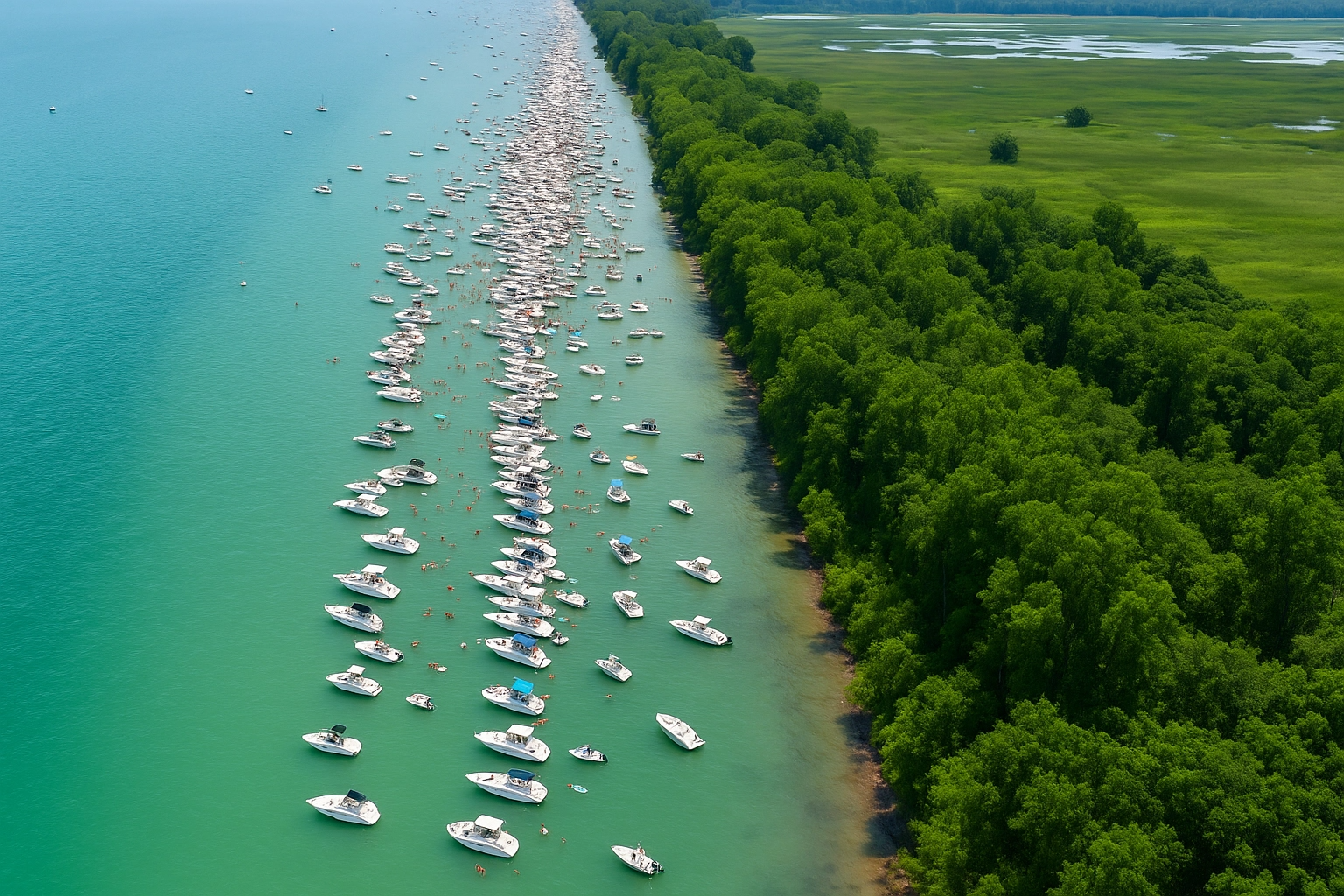
The Pottahawk Pissup is an unofficial, unsanctioned boat party held on the second Sunday of July at Pottahawk Point in Long Point Bay, Lake Erie. It is not an organized event. There are no official organizers, no tickets, and no formal schedule.
Dwayne Rodrigues
Boat Owner & Enthusiast
 Guides
Raft-Up Safety Mistakes That Cause Damage
There’s nothing quite like it. The sun is high, the water is warm, and you’re surrounded by friends, old and new, all tied together in a floating community. The raft-up is a cornerstone of the boating lifestyle, especially for events like Pottahawk.
Dwayne Rodrigues
Boat Owner & Enthusiast